
A practical field guide for RIAs evaluating a custom private fund strategy.
In public markets, the experience is simple by design. You can implement an allocation quickly, see performance cleanly, and move money with minimal friction.
Private markets are not built that way. Whether you’re a novice or experienced in launching private market vehicles, the opaqueness remains either a barrier to entry or an impediment to scale. Advisors underscore this: more than two-thirds cite the inherent complexity of private markets as a key challenge in client discussions, especially around mechanics like pacing, liquidity, and performance reporting.
That complexity is not what draws RIAs to private funds in the first place. It is simply part of the terrain. The question is less whether complexity exists, and more whether it is understood and planned for ahead of time.
A “custom fund,” as we define it, is a closed-end drawdown vehicle containing private funds or individual investments designed to give dozens of underlying investors easy access to private market exposure into a single, firm-aligned allocation. One that reflects your philosophy, your manager preferences, and the client experience you want to deliver. Instead of asking clients to evaluate and subscribe to a new private fund every time an opportunity appears, a custom fund creates a repeatable structure you can build on over time.
These vehicles are not new. They have been around for decades and have long been part of how institutions and many sophisticated RIAs allocate to private markets. They may not be the most talked about structure today, with evergreen funds capturing much of the attention, but there is a reason closed-end drawdown vehicles continue to represent a meaningful share of private market allocations. When implemented well, they have historically delivered strong outcomes and allowed wealth managers to access the best private managers.
At the same time, custom funds still feel like a big step, especially in the wealth channel. And that hesitation is rational.
When I speak with advisors who are considering this path, the concerns tend to be consistent:
This field guide exists for one reason. To make the requirements, tradeoffs, and ongoing expectations visible before you commit, so you can avoid common pitfalls, learn from peers who’ve been through it, and approach a custom fund with a clearer plan and fewer surprises.
How to use this guide
This is not a checklist you need to complete before moving forward. In practice, very few RIAs hit all of these signals at launch, and many successful custom funds were built while firms were still working through one or more of them.
Instead, think of this as a maturity map. These signals reflect where firms tend to arrive over time as they gain conviction, experience, and infrastructure. Some will resonate immediately. Others may feel aspirational. That’s expected.
The goal of this field guide is not to tell you whether you’re “ready” or not. It’s to help you understand what becomes important, when, and what tradeoffs you’re implicitly making at each stage.
Before thinking about structure, vendors, or managers, most firms find it helpful to get clear internally on one foundational question. How much illiquidity clients can bear and want to bear. That decision influences pacing, client segmentation, and which private strategies make sense, whether venture, credit, real estate, or a mix.
Why it matters: This is not just an allocation question. It is strategy-defining. In practice, RIA firms that have not aligned on illiquidity often find themselves revisiting core decisions later in the process, debating whether venture belongs in the mix, how much cash flow matters, or how patient clients truly are.
What we see in practice: Firms that handle this well are not guessing. They have had explicit internal conversations about how different client segments experience illiquidity, and they accept that not every private strategy fits every client, even within a custom fund.
What it affects downstream: Illiquidity assumptions shape portfolio construction, capital call pacing, and client communication.
Signal of progress: You can articulate a target private allocation range for the right clients and explain why.
Closed-end drawdown funds do not behave like public market allocations. Capital is called over time. Distributions arrive unevenly. Early performance can look unintuitive. It is not bad. It is simply different.
Why it matters: If you’re not managing the liquidity operations around the purchase of sale of private companies, the fund you’re investing in is. Avoiding dealing with them purely for the sake of convenience usually means they show up in the form of lower returns down the road.
What we see in practice: Clients rarely ask for drawdown funds explicitly. They care about results. Advisors who struggle here are often trying to make private markets feel like public markets, rather than setting expectations for how private investments actually work.
What it affects downstream: Client education, performance conversations, and confidence during early quarters when capital has been called but results are not yet visible.
Signal of progress: You’re aligned on the results you’re trying to achieve for clients and comfortable setting client expectations for their experience with private markets.
A custom fund only works if the client base supports it. In most cases, that means meaningful accredited investor density and, ideally, a material base of qualified purchasers. Your ability to access differentiated opportunities is partially a function of size, and banding your clients together can offer each of them a better deal than going it alone.
Why it matters: Eligibility is not just a legal box to check. It determines whether the vehicle can be diversified properly and whether capital can be deployed at the intended pace.
What we see in practice: RIA firms that underestimate this often rely too heavily on a small number of clients to make the math work, which introduces fragility if even one large investor chooses not to participate.
What it affects downstream: Portfolio construction, concentration risk, deployment timing, and the long-term viability of the vehicle.
Signal of progress: You know the percentage of clients eligible to participate and have evaluated the client portfolio implications to reach your target fund size.
Across the custom fund launches I have been involved in, investment leadership not being aligned on whether private funds can produce above market returns is perhaps the largest impediment. This challenge does not always show up as open conflict.
Why it matters: Misalignment does not fail loudly. It fails quietly. Capital raises underperform expectations, conviction weakens, and timelines stretch.
What we see in practice: Instead of refining strategy and communicating clearly with clients, firms spend energy internally debating whether the approach is right at all.
What it affects downstream: Fundraising success, advisor confidence in client conversations, and speed to steady state.
Signal of progress: There is consensus on the why and the how with key stakeholders identified and engaged to support execution.
Multi-manager custom funds often feel hardest at launch because the work is front-loaded. Identity documents, accreditation verification, client education, and onboarding all happen at once.
Why it matters: The upfront effort is what creates leverage later. Without it, firms often end up repeating the same work fund after fund.
What we see in practice: Launch quarter friction is frequently misinterpreted as a structural flaw, often accompanied by a flurry of emails, calls, and internal questions, when it is actually the cost of building a repeatable system.
What it affects downstream: Operational drag, tax complexity, advisor time, and the ability to scale commitments with ease over time.
Signal of progress: You are willing to invest effort upfront to gain long-term efficiencies.
Most firms we work with don’t hit all of these signals before they begin, and still launch custom funds successfully. Yet, even when the signals are there, some firms still hesitate. Usually, because they have seen or heard about custom fund launches that went sideways.
In practice, the most common failure points when launching a custom fund are not investment ideas. They are tied to execution.
The patterns that show up most often:
How firms de-risk these issues in practice:
Even if you don’t check every box today, reading through these risks and patterns gives you insight from peers who have already been through it—context many firms don’t have going in. You don’t have to start perfect to start informed.
Private markets will always be more complex than public markets. Yet, if the goals and strategy are aligned with your firm’s ethos for both the near term and long-term, navigating to the “how” becomes manageable. More than that, it becomes an org-wide action plan.
When the responsibilities are clearly understood, and the right infrastructure is in place, a custom fund becomes a practical way to deliver differentiated exposure, scale your process, and create a client experience that feels institutional.
This is what it means to set a new standard.
Gridline is a turnkey alternatives management platform built to set a new standard for private market investing. We work with RIAs to make private markets as easy to operate as trading stock, without sacrificing rigor or control.
Through our Custom Funds, Gridline helps RIAs launch and manage closed-end drawdown funds by providing a single platform for fund formation support, subscriptions, capital calls, performance reporting, and ongoing operations. The goal is simple. Absorb the operational complexity so advisors can focus on investment decisions and client relationships.
For a closer look at how Gridline supports RIAs launching closed-end drawdown vehicles, you can view our Custom Funds one-pager here.

Charles Patton leads manager selection, portfolio construction, and General Partner (GP) relationships at Gridline as Investment Director. Prior to joining Gridline in November 2022, Charles worked on Wells Fargo’s Investment Portfolio team and previously served as a Summer Associate at the University of Virginia Investment Management Company (UVIMCO). While earning his MBA at the University of Virginia’s Darden School of Business, he was Chief Investment Officer of Darden Capital Management. Charles holds an undergraduate degree from the University of North Carolina and is a CFA charterholder.
Client trust is earned through discipline. Asking the right private fund due diligence questions is essential because private funds demand more scrutiny than any other asset class. The universe of investible opportunities is vast, opaque, and often closed off. The challenge and opportunity are finding the funds that truly fit your clients’ risk and return expectations.
And in alternatives, the stakes are high: returns follow a power law, with a small number of investments generating most of the gains. That means the ability to source and win the right deals matters far more than broad exposure.
81% of advisors say private markets help differentiate their practice (Cerulli/Invesco/IWI, 2023). Yet as access to alternatives expands, the job of evaluating them gets harder, not easier. The rise of alt marketplaces means every fund looks accessible. But that doesn’t make them equal. And when performance is opaque or operations break down, it’s the advisor who’s left explaining.
Here’s a simple, practical checklist: five questions every advisor can ask before recommending a private fund. Whether you’re vetting a single manager or navigating a curated platform, this framework helps you cut through the noise and reinforce the trust you’ve built with clients.
In a crowded marketplace, it’s easy to mistake repackaged strategies for innovation. Look past the marketing veneer and ask: What actually sets this fund apart? Is there a proven edge in sourcing, execution, or timing, or is it simply tracking a trend?
Differentiation is best when it’s structural and repeatable, built on a manager’s ability to source and win the kinds of deals that consistently drive outcomes. Most advisors only see a half-built data set, a marketing deck, and some historical performance, but you need to compare the fund to firms of similar size, stage, and strategy to truly evaluate it.
What to Look For: If the marketplace doesn’t show you how a manager compares to peers—by vintage, strategy, or return profile—it’s not really helping you evaluate. Look for platforms that offer fund-level benchmarking and structured performance insights, not just a logo wall of access.
Not all “curated” platforms are actually vetting every investment opportunity. Some just aggregate. You deserve to know who underwrote the fund, how the manager was evaluated, and what risks were flagged—not just see a link to a PDF.
If you can’t articulate the diligence behind the fund, you can’t stand behind the recommendation.
What to Look For: The best platforms have dedicated investment teams doing institutional-style diligence on your behalf, and they’ll show you what they looked at and why it passed. Gridline was built from the ground up to bring operational discipline and deep manager rigor to every fund on the platform, not as a wrapper, but as an extension of your investment team.
Private investments demand patience. But that doesn’t mean performance has to be a black box. Advisors need a clear, consistent view into how a fund is performing and what’s driving the returns.
Are quarterly reports comprehensible? Do you have real-time dashboards? Is the data reconciled and client-ready, or cobbled together from scattered fund updates?
Your clients expect clarity. It’s worth expecting it in your tools as well.
What to Look For: Ask whether the platform delivers real-time, consolidated reporting and aggregation across all funds, down to the underlying holdings. Managing investor expectations with PDFs and guesswork can be avoided when your performance data is as transparent and openly available as possible—continuously updated, reconciled, and ready to share with clients. Gridline gives you the tools to show up sharp, not scrambling, with visibility built to power client confidence.
A private fund isn’t a strategy. It’s a vehicle. The real question is whether it fits your client’s objectives, income, liquidity, diversification, and complements their broader portfolio.
Too often, alts are bucketed into portfolios just to show sophistication. But sophistication without alignment creates more risk than reward.
What to Look For: The right platform can help you go beyond access and support thoughtful portfolio construction, built around your firm’s investment philosophy and client needs, not product pushes. Gridline’s approach brings clarity to construction, pairing recommendations with real risk alignment—so your client portfolios scale with intention, not guesswork.
Alternatives is a complicated business; operational drag at the subscription, capital call, or exit stage can undermine even the best investment. If the fund works but the operations don’t, everyone loses. You need to know:
Friction in onboarding or surprises at exit erode trust. Operational fluency is just as critical as investment performance.
What to Look For: Modern marketplaces often offer digital subscriptions, automated capital call tracking, and centralized document management. If the process still feels manual or patchworked together, you may end up carrying the operational burden. Gridline gives you a streamlined, scalable alternative, an integrated platform that grows with you, not around you.
There’s no shortage of private funds. The hard part is knowing which ones are worth recommending and which ones are just noise. In alternatives, returns tend to follow a power law; a small number of investments generate most of the gains, which means the ability to source and win the right deals matters far more than broad exposure.
As Logan Henderson, Gridline’s CEO, puts it: “The best returners are going to be a small subset of companies. You need to find firms and people who have access to the best possible opportunities that are going to deliver the outcomes your clients are demanding.”
That’s why we built Gridline, a turnkey alternatives management platform that matches your ambition with infrastructure. We help advisors bring institutional standards to private market investing, with clarity, control, and confidence built in.
Our Managed Marketplace gives you curated access to institutional-quality funds across venture, buyout, private credit, and real assets, paired with performance data, portfolio-aligned recommendations, and end-to-end operational automation. It’s everything you need to offer better alternatives, without adding complexity.
Because setting a new standard in private markets starts with asking better questions and having the right platform behind you.
Get access to institutional-quality alts, without the complexity. Create a free login to get started.
→ Explore the Managed Marketplace
Gridline, LLC is a technology platform and the owner of the software platform referenced herein. Gridline Advisors, LLC, is a Registered Investment Advisor registered with the state of Georgia. The content in this post is for informational purposes only and is not an offer to sell or a solicitation to buy any security. Alternative investments are speculative, involve a high degree of risk, including the possible loss of your entire investment, and are not suitable for all investors. Past performance does not guarantee future results. Interests in funds managed by Gridline Advisors, LLC, are available only to accredited investors. This material may contain forward-looking statements; actual results can vary materially.
Private markets are becoming a bigger part of the investment conversation among the fastest-growing RIAs, and a material driver of HNW and UHNW portfolios. Transparency and reporting quality now outrank track record as the #1 expectation LPs have from GPs (SS&C, Embracing the New).
Advisors are facing the same demand as they expand oversight in private markets. Today, they’re designing more sophisticated allocations, overseeing more fund exposure, and navigating more complexity than ever before. And they’re partnering with intelligent infrastructure that delivers the white glove service their clients demand and the operating levels their firm’s scale requires. Whether you’re managing a few funds or a firm-wide alts program, here’s a simple checklist to help you evaluate your current oversight and what “great” can look like when your infrastructure matches your ambition.
Ask yourself: Can I…
Instead of piecing together PDFs or spreadsheets to understand your private investments, a modern platform can collect, store, and standardize all of your fund documents and data, providing NAV, IRR, DPI, commitments, capital calls, and distributions in one place, continuously updated and reconciled across every fund and client. View performance instantly at the firm, client, or fund level, with metrics that are continuously updated and ready to share.
→ Real-time performance visibility and drill-down reporting fuel better conversations and smarter decisions by putting a complete, organized picture at your fingertips anytime you need it.
Documents and data can be centralized and reconciled automatically. From clean, client-ready reports to audit trails and compliance workflows, a modern platform is designed to remove friction, so you can focus on managing strategy, not formatting spreadsheets.
→ A back office that scales as smoothly as your investments keeps growth sustainable and creates more room for high-value client engagement and strategic planning.
Advisors don’t have to dig through a lengthy diligence document to understand why a fund is unique, they can have a short document that lays out the key points to answer client questions. Similarly they don’t have to compare two quarterly reports side by side, they can have a straightforward summary that provides key talking points without sifting through dozens of pages.
→ Confidence comes from a quick read through the right information, rather than sifting for what you really want.
Your private market platform can integrate with the reporting, billing, and custodial systems your team already relies on—like Orion, Black Diamond, Schwab, and Fidelity—to deliver a unified, end-to-end experience.
→ Integration makes private market investing feel as seamless as the public side while ensuring your team and clients always work from the same accurate, up-to-date information.
Oversight doesn’t have to slow you down—it can set you apart. The fastest-growing advisors are raising the bar, not by working harder, but by leveraging infrastructure built for what private markets demand.
Gridline is setting a new standard for private market oversight.
We’re bringing the transparency and reporting ease you’d expect from public markets to your alternatives portfolio with dedicated help on sourcing and structuring challenges unique to private markets. Designed as a Turnkey Alternatives Management Platform, Gridline rearchitected the entire system so you can give clients a clear, unified view of what they actually own.
Most legacy platforms were built to raise capital for fund managers, not to help advisors build and manage an alternatives portfolio. Gridline was purpose-built for advisors, streamlining the entire process, from portfolio construction to reporting. Its unified dashboard tracks capital calls, distributions, and NAV in real time, with AI-powered reconciliation and automated workflows that eliminate manual drag, so you spend less time preparing for meetings and more time showing up client-ready with comprehensive, up-to-date insights.
Whether you’re overseeing a few LP positions or scaling a full alts program, this checklist is a practical place to start elevating your oversight without adding complexity.
Gridline, LLC is a technology platform and the owner of the software platform referenced herein. Gridline Advisors, LLC, is a Registered Investment Advisor registered with the state of Georgia. The content in this post is for informational purposes only and is not an offer to sell or a solicitation to buy any security. Alternative investments are speculative, involve a high degree of risk, including the possible loss of your entire investment, and are not suitable for all investors. Past performance does not guarantee future results. Interests in funds managed by Gridline Advisors, LLC, are available only to accredited investors. This material may contain forward-looking statements; actual results can vary materially.
The business of sports has never been hotter. Once upon a time sports ownership was considered a trophy asset for local bigwigs, who purchased the team to see and be seen as much to generate a return. While there are still plenty of vanity ownership projects out there (Dallas Cowboys fans can certainly attest to Jerry Jones’ proclivity to make himself the center of attention), the ownership of major sports franchises has become considerably more professionalized over the past decade. After the NFL announced that it would allow private equity funds to purchase stakes in teams a few months ago, it completed a clean sweep of major American leagues who allow funds to invest minority growth capital into teams.
Why are investors interested?
It comes down to eyeballs, which drive dollars. Over the past couple of decades, the rise of streaming and smartphones has sent traditional TV viewership spiraling downward. Only 45% of TV watching households in America still subscribe to cable or satellite, down from a peak of almost 90%. This shift to streaming (which recently topped 40% of TV usage for the first time) depressed viewership for traditional cable, and importantly for advertisers puts a large chunk of viewership out of reach given the no or limited ad models preferred by streamers like Netflix. The result is that sports broadcasts now stand alone as the most viewed TV windows that are open to advertisers, averaging over 91 of the 100 most watched telecasts in 2023 and 2024.
Advertisers are unsurprisingly willing to pay top dollar for this rare content. That in turn means that networks pay the leagues an ever-increasing amount for content, for example NFL rights increased more than fourfold from 2006 to 2022 (the first year of the current contract). These broadcast rights are split amongst the teams, meaning that those team valuations have shot up alongside a bumper crop of revenues. The University of Michigan’s Ross School of Business tracks an index of Sports Franchises in concert with investor Arctos, and they estimate team values have risen at 14% annually over the past 20 years, doubling the annualized return of the S&P 500.
Why are existing owners willing to sell?
If the assets are so great, why are existing owners willing to part with them and make it easier for Private Equity to buy in? Part of the reason is succession planning. As many older owners pass away their children might not be able to or want to continue in a lead ownership role. Another is increased capital expenditures. As stadiums get more and more expensive (the NFL now has 7 stadiums that cost over $1B), existing ownership groups might not have the capital to afford new stadiums without institutional backing. Finally the valuations on teams are getting so high that even the wealthiest individuals don’t have the bankroll to purchase teams on their own or with a limited number of co-investors. Institutional pools of capital are required, hence the multi-billion dollar private equity fundraises.
Is there another way to play it?
While plenty of groups have lined up to take minority stakes in longstanding enterprises, others have sought to avoid the high valuations by purchasing stakes in teams from upstart leagues or creating new competitions from scratch. Monarch Collective and Ariel Investments are great examples of the former, investing exclusively in women’s sports at valuations in the hundreds of millions rather. New leagues abound, from TGL in golf to King’s League in soccer, often using the transformative celebrity of a founder like Tiger Woods or Gerard Piqué to draw eyeballs to a new league offering a less formal wrapper to a well-known sport. Other leagues like LOVB have attempted to put professional structure behind sports that usually receive significant attention around the Olympics, often using social media and behind the scenes footage to connect with fans directly. Plenty of ancillary businesses have benefitted from the rise in sports enterprise values, like data-driven sports marketer Two Circles who has been able to expand into a global sports marketplace. As valuations continue to increase and more professional ownership groups seek to drive value at these teams, it seems likely that outsourced specialists will gain market share from internal franchise by franchise efforts.
Any way you choose to view sports investing, what seems clear is that the business of sports has never been bigger and seems unlikely to slow down anytime soon. Given the dearth of public market opportunities to invest in the sports ecosystem, we remain believers that private markets should be an instrumental part of any sports investor’s toolkit.
What do cookies, protein shakes and high-end luxury consumer brand items all have in common?
Other than being fun and unique products to “Add To Cart” during an online or in-person shopping jaunt, they also represent a small component of the $8.3 trillion1 of annual personal consumer expenditure in retail trade and restaurants that presents a massive opportunity for consumer-focused private equity investors. At 30% of US GDP2 and 45% of personal consumption expenditure3, this slice of the economy covers food & beverage, consumer brands, restaurant and retailer activity within the United States.
Take for instance, the “consumer brand investing success story”4 that is Tate’s Bake Shop, a well-known gourmet cookie brand that is widely available at Publix and Costco. As part of their methodical research surrounding evolving consumer tastes, Riverside honed in on the shifting consumer preference for all-natural and gourmet dessert options5. Riverside gave Tate’s the resources they needed to expand and enhanced Tate’s distribution, production, and manufacturing efficiency.4
Riverside fostered Tate’s strong relationships with retailers – enabling Tate’s to understand changing customer needs and preferences – and develop unique products like snack-sized “Tiny Tate’s” and on-trend flavors like Ginger Zinger and Coconut Crisps. Riverside also enabled Tate’s to be able to meet this demand through cultivating strong relationships with Tate’s distributors. Tate’s was sold to Mondelez International (an international food conglomerate) for $500MM,4 a great outcome for Riverside’s investors and for Kathleen King who first opened the roadside cookie stand.6
Within this opportunity set, private equity investors conduct significant research surrounding changing consumer preferences and deploy capital in companies which are poised to capitalize on one or many of these consumer trends at various sizes and stages. Private equity investors take a “treasure-hunt” approach, sometimes honing in on a small upstart at the intersection of multiple compelling themes or finding a highly recognizable brand with deep customer affinity and empowering them to grow in new sectors through expansion capital and strategic oversight. At each stage of a consumer-focused company, private equity aims to bring operational improvements, industry insights, and best-in-class partnerships to the table.
In addition to demand for all-natural and gourmet dessert options, consumer preferences highlight an increased focus on wellness. Only What You Need (OWYN), a plant-based protein beverage, was founded by two former professional athletes in 2017.8 Catering to a health and wellness focused demographic, OWYN’s ready-to-drink protein shake excludes sugars, syrups, and saturated fats,9 as well as the top eightallergens.9 Initially launched via e-commerce, OWYN received patient capital and strategic guidance from Purchase Capital in 2022.10 OWYN continues to experience double-digit revenue growth and is expected to have $120MM of net sales in 2024.10 OWYN now outsells legacy brands like Muscle Milk and is carried in Kroger, Target, Publix and Whole Foods nationwide. It was recently acquired by Simply Good Foods, a developer, marketer and seller of branded nutritional foods, for $280MM in cash.11
The wellness trend has also expanded to beauty, where it accounted for an extra $46B or 30% of market value to the overarching US beauty sector, which presently stands at $148B.12 Beauty is a small component of the overarching consumer brand sector, which includes clothing, footwear, pets and more. Clothing and footwear alone represented $1.4T of economic activity within 2023.7 Within the consumer brand sector, luxury brands have outperformed market indices, while non-luxury brands have lagged – which has increased caution amongst investors for the non-luxury category.13 This rings true within beauty as well, with North American luxury beauty sales growing 15% in 2023.12
All of these metrics highlight how highly recognized brands with deep affinity amongst their customer base have been able to pass along cost and price increases to consumers, without suffering a dip in demand, relative to less differentiated counterparts. Unlike their commoditized counterparts, unique consumer brands capitalizing on key consumer themes and trends require a well-developed network of relationships to source, as well as deep understanding of the sector to implement operational improvements and long-standing partnerships.
Despite a slowdown in consumer M&A activity in recent quarters due to softened consumer sentiment from rising rates, KPMG projects that 2024 consumer-focused M&A is set for an upswing. Private equity investor confidence in the consumer sector has increased, driven by the first of many forecasted rate cuts from the European Central Bank and other global central banks, larger deals and rising IPO activity.12
At approximately $18.6 trillion14 and representing nearly 68% of the U.S. GDP, consumption is the primary driver of the U.S. economy and presents a massive opportunity for attractive growth investments. Real* personal consumption expenditure experienced an average 3% year-on-year growth rate over the last decade.15 Investors would do well to consider dedicated consumer allocations within a diversified portfolio, as missing out on a large and steadily growing slice of the economy might prove costly over the coming years.
*Real personal consumption expenditure is adjusted for inflation
Sources
When IBM chairman Thomas Watson was selected to serve as ambassador to the USSR in 1979, he had a problem. Ethics norms of the time dictated he needed to dispose of his personal stakes in several VC funds he’d accumulated over years of investing in the early computing industry. Watson tapped Dayton Carr to help market the fund interests. After significant effort, Carr found willing buyers in the nascent private markets ecosystem to complete the sales. This convinced Carr to set up the world’s first dedicated secondaries firm, Venture Capital Fund of America, to pursue the strategy full-time.
The industry Carr helped birth more than four decades ago has spread across every major private market asset class and transacted more than $112B of volume in 2023. Secondaries have become an increasingly important arrow in the quiver of private market allocations available to investors, whether because of competitive returns, diversification, or quicker cash conversion cycles.
We believe now is a particularly advantageous time to tap the secondaries markets with discounts to net asset value above pre-COVID averages across asset classes and even further above average in more niche spaces like venture. To that end, we’ve taken steps to bring high-quality secondaries opportunities to our member community.
I’ve put together a primer on the history of secondaries, different segments that have evolved, and what the data indicates about performance. I invite you to have a read and let me know what you think.
-Charles Patton, Director, Investments
To view and download full details of the funds on our platform and in future emails like these, visit app.gridline.co/signup and answer a few quick questions that allow us to verify your identity and learn about your allocation strategy. There is no cost or commitment to create an account on Gridline.

Many of the same common sense principles for crafting a balanced portfolio that performs over the long term apply across both public and private. Read More
We expect to see investors of all sizes deploy more capital into secondaries. Explore our primer on the category’s history, segments, and performance. Read More
When IBM chairman Thomas Watson was selected to serve as ambassador to the USSR in 1979, he had a problem. Ethics norms of the time dictated he needed to dispose of his personal stakes in several VC funds he’d accumulated over years of investing in the early computing industry. Watson tapped Dayton Carr to help market the fund interests. After significant effort, Carr was able to find willing buyers in the nascent private markets ecosystem to complete the sales. This convinced Carr to set up the world’s first dedicated secondaries firm, Venture Capital Fund of America, to pursue the strategy full-time.1 Carr ended up nurturing several industry luminaries, including Jeremy Coller (CEO of Coller Capital) and Andrew Isnard (CEO of Arcis Group).
Today, the industry Carr helped birth transacted $112B of volume in 2023 and has spread into every private asset class.2 Whether because of competitive returns, diversification, or quicker cash conversion cycles, secondaries have become an increasingly important arrow in the quiver of private market allocations available to investors. This article will walk through two common types of secondaries deals, recent trends in different corners of the market, and things for investors to keep in mind before jumping in.
Watson’s quandary is an example of the original form of secondaries transactions, LP stake sales. These involve Limited Partners (LPs) looking to sell private fund interests and secondaries managers hoping to acquire them for less than their intrinsic value. LPs might be looking to sell because of shifting strategic mandates, idiosyncratic personal factors, loss of conviction in a manager’s strategy, or to free up liquidity. Buyers are tempted by typical discounts to Net Asset Value (NAV) at purchase, a shorter runway to liquidity as typical sales take place in the latter years of a fund’s life, and a mostly known and well-diversified portfolio.
Many private fund contracts require General Partner (GP) consent before interests are transferred, which means the GP must approve LP stake purchasers before any sale. This is especially true for Venture managers, who can be sensitive about allowing new investors into the partnership who might publicize portfolio company information. These dynamics help existing LPs in a fund get a leg up when purchasing stakes, as they can be trusted not to circulate information and are knowledgeable enough about the portfolios to ascertain their true value. Because that pool of LPs is often smaller than buyout funds, bidding for venture portfolios tends to be less competitive.
As secondary markets developed, a pattern of LPs looking to unload interests in long-dated funds emerged. Because fund interests might be a bit small by that stage of a fund’s life, LPs might not get great asset pricing. GPs became aware of this dynamic and introduced continuation funds, where LPs would be given the option to sell their interests in one large block and hopefully fetch a better price. GPs are quite enthusiastic about the prospect as it allows them to reap significant carry when LPs extinguish their fund interests and restart the clock on fee income (which GPs receive from new purchasers in exchange for continued management of the assets). Less cynically, they can also allow GPs to pursue more long-term value enhancement plans rather than forcing assets to market prematurely.
From a purchaser’s perspective, continuation vehicles offer the chance to purchase significant exposure to a concentrated portfolio. Because managers typically run a bidding process for the right to participate, secondaries purchasers can get an opportunity to learn more about the assets they’re purchasing, particularly if they are less familiar with the manager. In the words of one market participant, “Managers can sell these assets to any number of people.”3 This same broadly marketed process usually means more competitive pricing, requiring purchasers to be spot on when forecasting portfolio company growth.
Whether on the LP or GP side, this market environment has been conducive to significant secondaries volume. Jefferies estimates that 2023 was secondaries’ second-largest year behind 2021, with volume fairly evenly split between GP continuation vehicles and LP stake sales.2 LP volume was dominated by Pensions and Sovereign Wealth Funds, which is perhaps unsurprising as they are the largest individual pools of capital. On the GP side, higher rates made the traditional exit routes of IPOs, M&A, and dividend recaps scarce, creating a strong opportunity for continuation funds to provide liquidity. Continuation funds reached an all-time high of 12% of global sponsor-backed exits, more than double the average for the previous 3 years.2
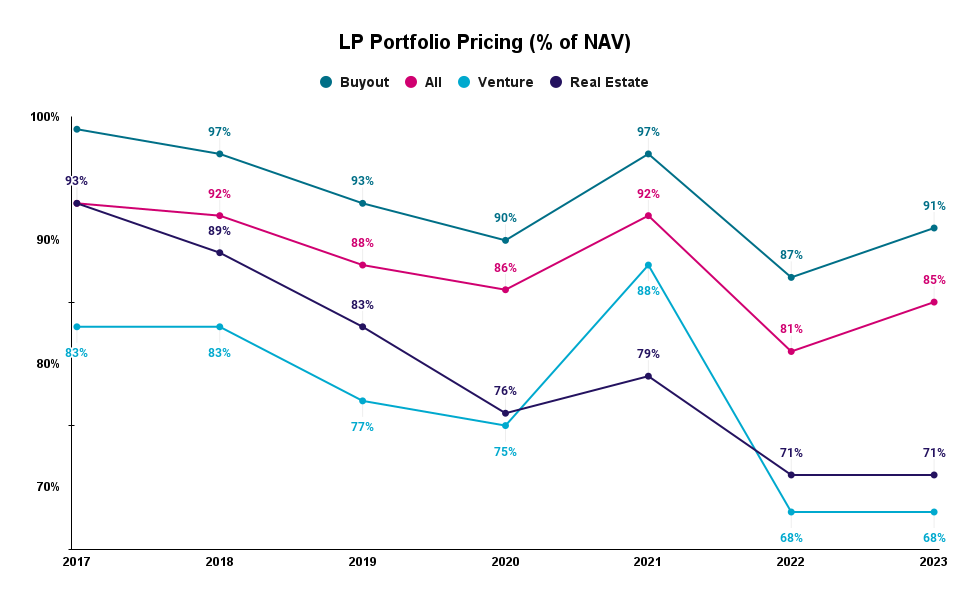
The thirst for liquidity has had a knock-on effect on pricing. Below, you’ll find a graph of annual pricing on LP deals across asset classes, where eagle-eyed readers will note that every asset class priced below its pre-COVID average in 2023. However, this was far from evenly distributed as buyout deals rebounded to 91% of NAV while venture pricing remained depressed at 68% of NAV. Part of this spread is due to differences in valuation policies, as buyout managers are often slower to write up portfolio companies than VCs, who typically write up portfolio companies every 1-3 years as they raise additional rounds of capital.4 Those external VC rounds are usually a strong anchoring point for venture valuations, which means that venture managers are slower to write down the value of their portfolios in a downturn.
Beyond technical pricing differences is a supply and demand mismatch. Jeffries pegs the dedicated capital available to pursue secondaries at an all-time high of $255B or 2.3x the market’s volume.2 Most of this dry powder has been raised to pursue buyout opportunities, including $23B for Lexington Partners’ latest fund5 and $25B for Blackstone’s most recent vintage.6 By contrast, the closed nature of many venture secondaries opportunities, smaller opportunity sets, and the higher bar on the diligence of rapidly changing venture-backed companies makes it more difficult to deploy capital at scale. This shows up in the fundraising figures, with the largest secondaries fundraises dedicated to venture Industry’s recent $1.7B vintage7 or StepStone’s $2.6B 2021 close.8
Finally, investors should consider how private secondaries compare with public markets. In the past year, the S&P 500 is up 28%, and the NASDAQ-100 is up 50%.9 Cambridge Associates’ most recent one-year buyout performance was pegged at 6.4%, while venture turned in a -10.4% return.10 So while private company valuations might have looked stretched relative to their public peers in 2023, the growth of public comps mainly fueled by multiple expansion makes the concern less salient in 2024.11
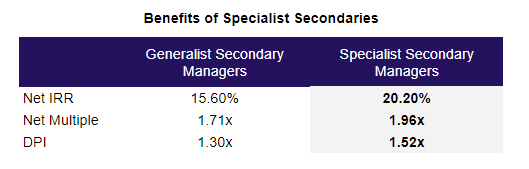
There is strong evidence that more niche secondaries managers engaging in less competitive bidding processes can produce outsized returns. Phil Huber at Cliffwater recently put out a note that segments the secondaries landscape into generalist firms with larger fund sizes and broader remits and specialist firms focusing on a narrower slice of the market.12 He found that Specialists outperformed by ~5% per year across a 250 fund dataset. This makes sense, as we would expect excess returns to be eroded in markets with more dry powder outstanding.
Bringing it all together, investors can benefit significantly from secondaries funds due to a faster payback period than primary investments, increased diversification, and competitive returns. Now is a particularly advantageous time to tap the secondaries markets with discounts to NAV above pre-COVID averages across asset classes and even further above average in more niche spaces like venture. Higher prices for public stocks make these entry points more valuable on a relative basis. When considering how to play the space, investors should consider the degree to which specialization gives a manager they are considering partnering with a relative advantage.
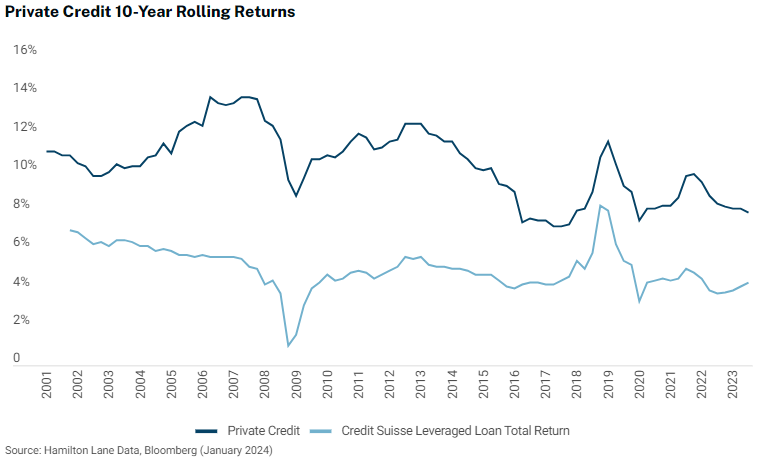
Hamilton Lane published a good note about building a robust private markets portfolio. It shares many of our views about why high-net-worth portfolios should move from 3% allocations to private markets to closer to an institutional ~25%, including diversification and a declining number of public companies for investors to choose from. More persuasive are the return benchmarks, which show global Private Equity easily outpacing world stock markets and Private Credit comfortably exceeding their closest analog, leveraged loans.
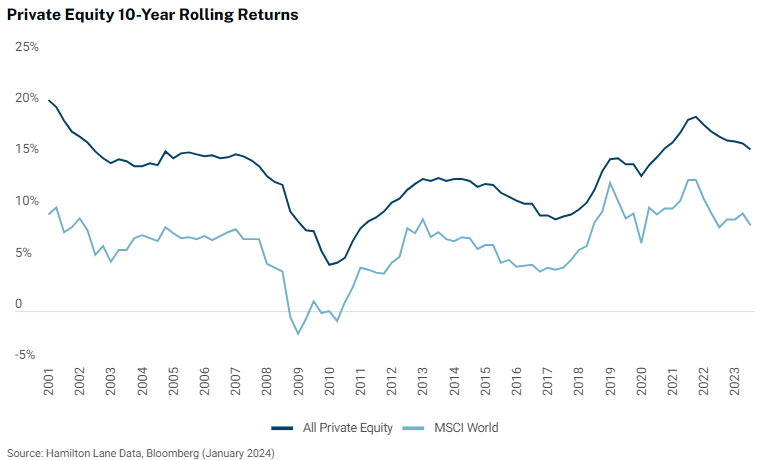
The note goes on to spell out the key factors that need to be managed when building a private markets portfolio, including:
We agree wholeheartedly, and that’s why Gridline has been transparent about not overpromising and underdelivering on liquidity, simplified call schedules for underlying investors, and assembled an investment team focused on sourcing the most compelling private market opportunities. Because that team gets to tap into Hamilton Lane’s Cobalt database, we get insight into many of the same opportunities Hamilton Lane focuses on. However, we would add two complexities investors have to manage that went under-discussed in the article.
The first is investment minimums, which can prove especially challenging to meet for those looking to access top-performing flagship funds rather than made-for-retail funds with different deals. The second is accessing performance and tax information, which can prove cumbersome for an industry that typically provides reporting updates via emailed PDF. We’ve worked hard to solve both problems with minimums ranging from $50K to $250K (due over several years) and consolidated tax and performance reporting.
If now is the time to reexamine your portfolio allocation, I’d be happy to walk through the opportunities available on the platform today.
-Charles Patton, Director, Investments
To view and download full details of the funds on our platform and in future emails like these, visit app.gridline.co/signup and answer a few quick questions that allow us to verify your identity and learn about your allocation strategy. There is no cost or commitment to create an account on Gridline.
Carta consolidated insights from their expansive dataset to enable informed decisions and illuminate market conditions. Read more.
Michael Sonnenfeldt, the founder of Tiger 21, appeared on CNBC last week to discuss “Where the Super Rich is Investing.” He speaks to insights from the global ultra-high-net-worth networking group’s latest Asset Allocation Report.
A few takeaways:
We see these trends reflected in the investment patterns of ultra-high-net-worth investors who leverage Gridline to build their own high-performing portfolios.
But it’s not just the super-rich.
Accredited investors, whether directly or via their investment advisors, are leveraging Gridline Thematic Funds to build portfolios that resemble those of more substantially capitalized investors.
– The Team at Gridline
In 1969, a team of researchers at UCLA sent the first message between two computers to Stanford on the Advanced Research Projects Agency Network (ARPANET). Often known as the forerunner of the internet, ARPANET was funded by the Department of Defense to link research institutions with government grants to speed technological development. It only took a few years for one of the academics, Bob Thomas, to create a program named Creeper that could track network activity and report back its findings. This was quickly followed by Ray Tomlinson’s Reaper antivirus software, which chased and deleted Creeper wherever it was found.
This tit-for-tat between Bob and Ray is the first example of cybersecurity in action, and for the past five decades, the battle between those looking to penetrate online networks and those erecting defenses has continued to escalate. In 2023, end-user spending in the market for information security from cyber attacks was projected to reach $188B, which would represent 11.3% growth from 2022. Estimates for how large this market can get vary widely, but a study by McKinsey pegged the top end at $2 trillion.
Why does such explosive growth appear likely? One way to approach that question is to consider how much cybercrime costs today and how that’s likely to change. The team at Cybersecurity Ventures estimated that cybercrime would cost $8 trillion in 2023 and $10 trillion by 2025 due to a host of costs, including data destruction, stolen money, IP theft, and reputational harm, among others. Another barometer includes surveys of top executives purchasing cyber defenses as they are the ones writing the checks. Morgan Stanley asked 100 Chief Information Officers in early 2023 about which programs would receive the largest spending increase, and Security Software came first.1 More revealingly, when asked which programs are most likely to be cut, none of the CIOs mentioned Security Software.
Not only is explosive growth possible, but there are reasons to believe startups will have an outsized role to play in defending against the next generation of attackers. One is that entrepreneurs can structure their firms to prevent today’s threats. Cyber professionals have already started to see Generative Artificial Intelligence (AI) contribute to cyber attacks by making it cheaper for groups to run spear phishing or automated customer support scams. The US government has noticed, setting up an AI Security Center within the National Security Agency (NSA) to guard sensitive information that can’t always be addressed with third-party software. Similarly, advances in quantum computing threaten to make many current encryption methods obsolete. Companies built to stop these new vectors of attack stand to benefit if they can outperform legacy players, and historically, incumbents have struggled to innovate on new products while staying at the cutting edge of their existing products. This is especially easy because experienced cyber operators can offer consulting services independently to generate revenue while developing the next software program to productize their insights.
Considering the size and growth of the cyber market, you might expect the venture industry to be rushing headlong into cyber. TechCrunch’s data disagrees, and they estimate Security startups only raised $2.7B in funding over the first quarter of 2023, down 58% year over year. Beyond a general funding malaise, VCs also might be reacting to the difficulties in investing in the space as a generalist. Cyber-specific VCs enjoy advantages on the sourcing side because their relationships with executives purchasing cyber solutions can help startups get a foot in the door with potentially huge clients. They are also advantaged with investment diligence because extensive experience allows them to more easily separate overhyped players from true security breakthroughs. This is crucially important in an industry where companies can grow revenue before the flaws in their security solutions manifest.
Cybersecurity is an industry ripe for continued growth and disruptive innovation. As investors consider how they want to position portfolios against potential disruptions from AI or quantum computing, it would be wise to consider how cybersecurity investments could function as an (imperfect) hedge. We are excited to see how the space develops in the years ahead and hope that those building protective walls outpace bad actors seeking to scale them.
Happy holidays! I’m Charles, taking over for Logan in this edition of our newsletter. We wanted to take this opportunity to review our 2023 predictions and grade our predictive performance. We think we did a pretty good job, given that 2023 was a volatile year for investing, but we’ll let you be the judge.
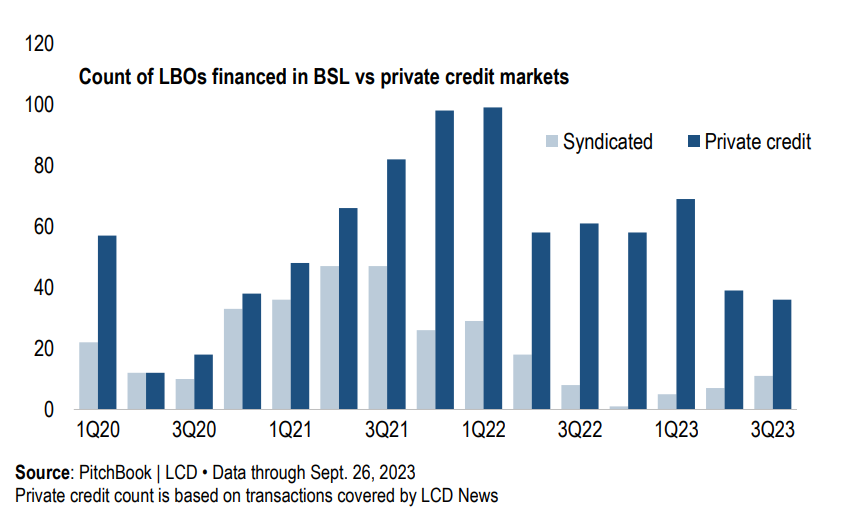
In January of last year, the writing was on the wall that banks were not going to be able to extend the type of credit that they did in the lower rate environment of 2020-2022. The collapse of Silicon Valley Bank, Signature, and other mid-sized banks accelerated this trend. This meant that every surviving bank smaller than the behemoths focused on shoring up their own balance sheets rather than lending more aggressively. The best data on this comes from PitchBook LCD, which tracks loans used to fund buyouts from private credit and the syndicated markets preferred by banks. Their Q3 update showed that the gap between buyouts financed by private credit and syndicated loans was at its widest point ever in 2023, and their figures likely understate the extent of the transition as they only track larger deals.
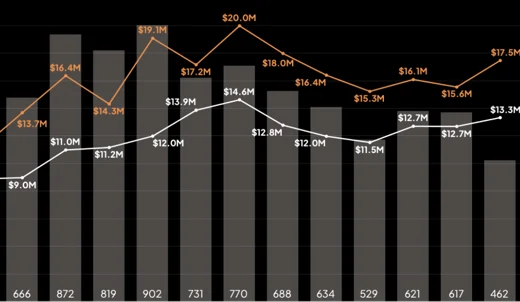
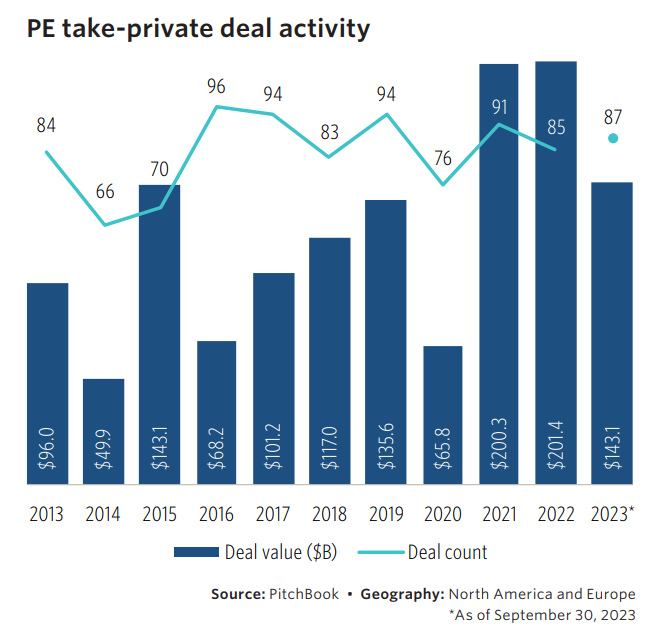
Take-private transactions in 2023 are even with 2022’s figures through 3 quarters by count and running a bit behind on dollars (numbers courtesy of PitchBook). That’s because deals in 2023 were slightly smaller than the past couple of years, a trend that accelerated in Q3 as 2/3rds of take privates were under $1B against a long-term average of 55%. Large take privates have not disappeared, though, evidenced by deals over $10B for Toshiba, Worldpay, and Qualtrics.
Sponsor acquisitions held steady in 2023 per PitchBook at 44% of exits, as corporate buyers continued to snap up PE-backed firms rapidly. Our rationale for sponsor-led acquisitions was sound, though, as the IPO markets remained largely closed, and only 1% of exits were to the public markets.
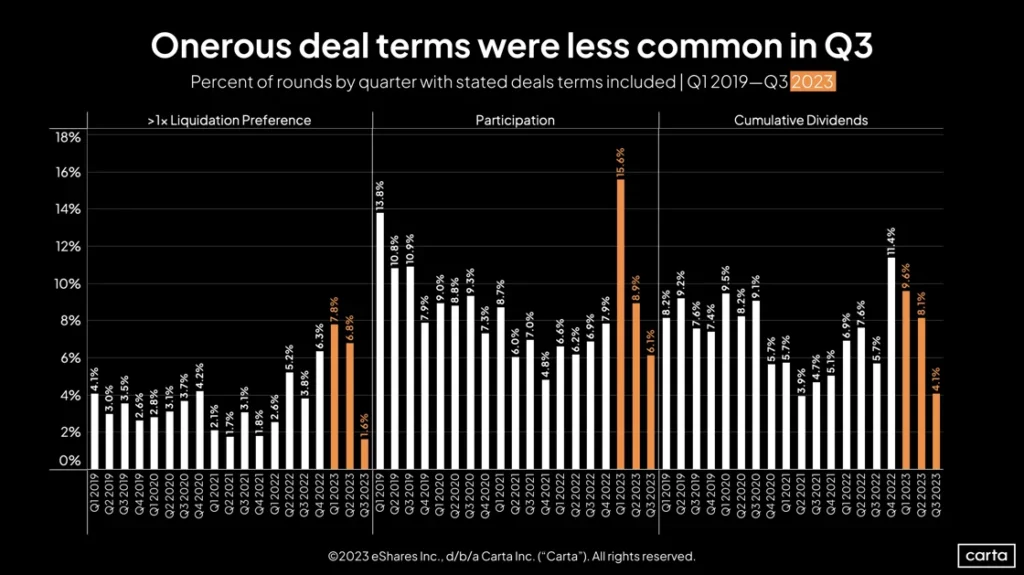
The best data source here is Carta, which publishes a quarterly report on venture trends using the proprietary data they have on over 41,000 venture-backed firms. The graph below shows the percentage of deals in a given quarter that included three common protection provisions: a liquidation preference, participation, and cumulative dividends. All three effectively allow venture capitalists to capture more of the value from a company’s exit if that exit is less than a home run. These terms either reached or neared cyclical highs in the first quarter of this year, a sign that venture investors were interested in protecting their downside. Founders were willing to accept them because they wanted to avoid a drop in headline valuations, though as the year wore on, more founders became willing to accept a lower valuation rather than load up the deal with protection provisions. The numbers below likely understate the extent of the shift, as the later-stage deals that more often include protection provisions were less common while early-stage deals held steady.
The headwinds definitely came for real assets in 2023 in the form of higher interest rates, which sent home sales tumbling to post-financial crisis era lows. This had a knock-on effect on private real assets fundraising, which followed a bumper year in 2022 with “the worst fundraising market in a decade.” The strategic opportunities in the space have indeed opened up, as areas like industrial outdoor storage and cell towers continue to see healthy demand.
In January, we will publish our quarterly outlook for Q1 2024. Until then, have a safe and happy holiday from everyone here at Gridline.
-Charles Patton, Investment Team
To view and download full details of the funds on our platform and in future emails like these, visit app.gridline.co/signup and answer a few quick questions that allow us to verify your identity and learn about your allocation strategy. There is no cost or commitment to create an account on Gridline.

Discover GP Stakes Investing: a unique blend of growth and stability for private market investors. Dive further into this innovative strategy with Gridline’s insights. Read more.
This past year, our engineering team rolled out dozens of innovations that improve private market investing.
These include features that provide greater portfolio transparency, like our Fund Activity View, as well as innovations that our investors don’t always see, like automated fund administration. Together, this allows us to create a world-class investor experience along with industry-low fees and minimums.
A perfect example of the streamlined investing experience we’ve created is that in 2023, on average, it took investors just 4 minutes to complete an investment from start to finish, including receiving funding instructions.
We look forward to continuing to deliver on our mission of delivering an unparalleled private market investing experience in 2024.
– Peter Bilali, VP Platform