
This month, our team attended the T3 technology conference in New Orleans, where everyone attending was wondering the same: how will AI reshape advisory firms?
Here’s what we heard.
AI is no longer a tool-level conversation. Firms are stepping back and rethinking how the business runs: where time goes, where things break, and how teams are structured. This is starting to change the work itself, not just the tools around it.
Most RIAs are already using AI in some form. So the question isn’t who’s using it. It’s what actually changes because of it. Here are the three themes we heard most:
Firms are experimenting with new tools, but confidence in the outputs is still low, especially in compliance, documentation, and client communication.
Takeaway: As AI becomes more embedded, trust and compliance won’t be side considerations, but core buying criteria.
AI is exposing a more fundamental need. It’s not about just having better tools, but better data too. If data isn’t owned, structured, and consistent across the firm, AI amplifies the gaps instead of fixing them.
Takeaway: Firms that invest in data integrity and ownership will pull ahead. Over time, this will become valuable IP, not just infrastructure.
We can all agree AI will reshape how we work, but not in a fully predictable way. In wealth management, it’s less about jobs disappearing and more about how the work changes.
Takeaway: The practitioners who learn how to integrate AI into their workflows will become exponentially more effective than those who don’t.
This shift is already taking shape in how some firms are structuring diligence and workflow.
Editor’s Note: This is a redacted copy of the monthly Gridline newsletter. To receive more content like this in full, subscribe to our newsletter on the bottom of the Resources page.
For many RIAs, Q4 isn’t just another quarter. It’s when preparation and process combine to create a hallmark of advisor excellence.
In his latest article, Doug Dougherty, Senior Advisor at Gridline, shares how top firms are transforming tax-loss harvesting (TLH) from a reactive year-end task into a proactive, system-driven discipline that adds measurable after-tax value.
Here’s how leading advisors are evolving their approach:

Gridline CEO, Logan Henderson, joined Avidian Wealth Solutions CIO, Jake Borbidge, on the Ask Avidian podcast to discuss how AI, infrastructure, and transparency are redefining advisor access to private markets. Tune in
Insights from Gridline’s recent CIO Roundtable
Advisors and CIOs are navigating an inflection point in private markets. Opportunity is growing, but so is complexity. In our latest roundtable, three themes stood out:
Private Equity: CIOs are drilling deeper into valuation discipline, and beginning to see a valuation gap open up between smaller firms with less than $25MM of EBITDA (or operating profits) and larger platforms above that mark.
Secondaries & Continuation Vehicles: CIOs are seeing a lot of activity in the secondary space but have varied return expectations, particularly for firms specializing in continuation vehicles (CVs). Because CVs are fairly new to the broader market, there is less data to rely upon for projecting performance.
Hedge Funds: Quietly regaining relevance. CIOs are re-evaluating where hedge fund strategies fit in portfolios, especially for uncorrelated exposure in today’s environment.

Hamilton Lane’s Quarterly Private Markets Brief strikes an optimistic tone, signaling that while activity remains below peak levels, the storm is starting to clear. With rate cuts on the horizon and deal flow slowly returning, the question is: can the recovery hold amid continued economic and policy uncertainty?
There’s growing momentum behind evergreen and semi-liquid funds as a “better” way to access private markets. On the surface, the appeal is clear: lower minimums, easier onboarding, and more frequent liquidity windows. But when every fund starts to look the same, and “hundreds upon hundreds” of new evergreen vehicles flood the market, we should pause to ask, “who is this really built for?”
In many cases, the answer isn’t the end investor. It’s the distributor.
The rise of evergreen funds reflects a broader trend in the wealth channel – packaging is becoming the product. Designed to capture flows, not necessarily deliver outcomes, these funds emphasize access and scale over alignment and performance. Liquidity is often promoted as a core benefit, but in practice, it can be more illusion than reality. A 5% quarterly redemption limit might suffice in steady markets, but when volatility spikes and investors rush to exit, good luck.
Rapid capital deployment, a hallmark of many evergreen structures, can backfire in asset classes that require thoughtful pacing. The 2020-2021 growth equity vintages offer a cautionary tale with too much capital deployed too quickly, inflated valuations, and compressed returns. In long-duration strategies like private equity and venture, disciplined deployment over time isn’t a constraint; it’s a competitive advantage.
At Gridline, we believe the future of private markets isn’t just about more access.
At Gridline, we seek to provide interesting insights that aid in your investment decision-making alongside access to best-in-class fund managers. As we kick off the second quarter of the year, we want to update you on the trends we are currently seeing and highlight new features available on the Gridline platform.
We’re also honored to be selected as one of the “Top 10 Most Innovative Companies in Georgia” for 2024. This validation is core to our thesis that the antiquated and labor-intensive processes built by legacy service providers do not scale to 100,000+ financial advisers and millions of accredited investors looking to build better portfolios of alternatives. We have built a vertically integrated infrastructure by integrating sourcing, transacting, and custody while streamlining the investor journey of discovery, execution, and reporting.
We welcome your feedback and invite you to become a Gridline member today.
-Logan Henderson, CEO

Mechanism design, often hailed as ‘reverse game theory,’ finds significant application in the private markets. Read More
When IBM chairman Thomas Watson was selected to serve as ambassador to the USSR in 1979, he had a problem. Ethics norms of the time dictated he needed to dispose of his personal stakes in several VC funds he’d accumulated over years of investing in the early computing industry. Watson tapped Dayton Carr to help market the fund interests. After significant effort, Carr found willing buyers in the nascent private markets ecosystem to complete the sales. This convinced Carr to set up the world’s first dedicated secondaries firm, Venture Capital Fund of America, to pursue the strategy full-time.
The industry Carr helped birth more than four decades ago has spread across every major private market asset class and transacted more than $112B of volume in 2023. Secondaries have become an increasingly important arrow in the quiver of private market allocations available to investors, whether because of competitive returns, diversification, or quicker cash conversion cycles.
We believe now is a particularly advantageous time to tap the secondaries markets with discounts to net asset value above pre-COVID averages across asset classes and even further above average in more niche spaces like venture. To that end, we’ve taken steps to bring high-quality secondaries opportunities to our member community.
I’ve put together a primer on the history of secondaries, different segments that have evolved, and what the data indicates about performance. I invite you to have a read and let me know what you think.
-Charles Patton, Director, Investments
To view and download full details of the funds on our platform and in future emails like these, visit app.gridline.co/signup and answer a few quick questions that allow us to verify your identity and learn about your allocation strategy. There is no cost or commitment to create an account on Gridline.

Many of the same common sense principles for crafting a balanced portfolio that performs over the long term apply across both public and private. Read More
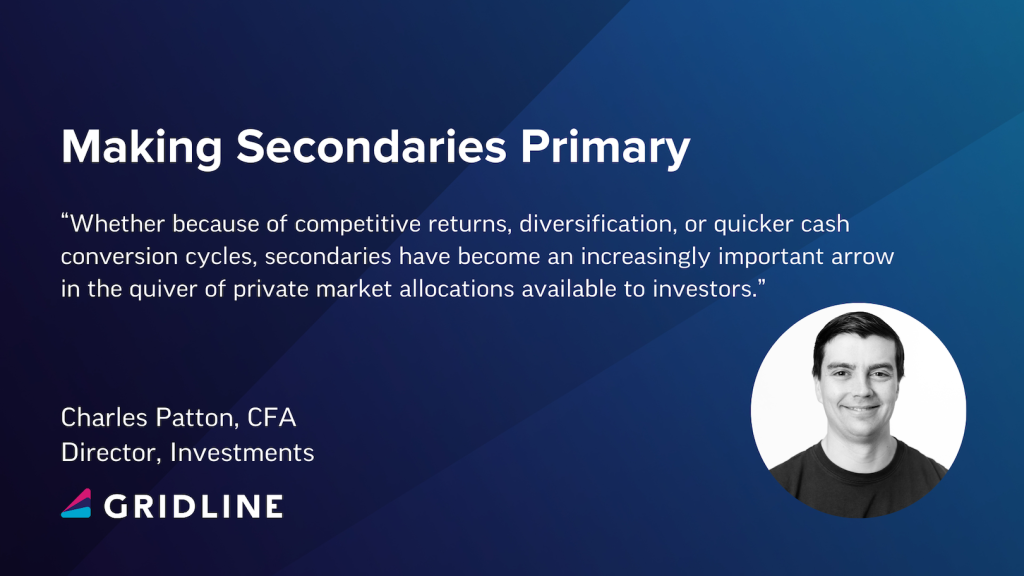
We expect to see investors of all sizes deploy more capital into secondaries. Explore our primer on the category’s history, segments, and performance. Read More
The term “emerging manager” can be misleading, often suggesting a manager that’s green, just starting out as an investor and relying on their first limited partners to take a risk on them while they build a track record. In reality, many emerging managers are quite the opposite. They are seasoned entrepreneurs and professional investors who’ve launched their own fund to capitalize on their unique sector ascendancy and have a long queue of investors who are justifiably eager to back them.
Capitol Meridian Partners (CMP) is one such fund. The team, led by industry veterans Brooke Coburn and Adam Palmer, recently announced the close of their first fund, raising $900M in capital, both exceeding the fundraising target and hitting the hard cap.
We participated in Capital Meridian Partners Fund I alongside more than 30 institutional investors, including endowments, foundations, pension funds, and others. We’d like to take a moment to congratulate the team at CMP and reflect on not only why we invested but also why we believe they’ve seen such great success in a challenging environment.
While many investors may be hesitant to invest in a first-time fund manager, these emerging managers are often the most successful at creating alpha for their LPs. It’s important to look beyond their emerging status and consider the team’s background, strategy, and philosophy. Congratulations again to the CMP team; we are excited to see what’s next.
-Logan Henderson, CEO
To view and download full details of the funds on our platform and in future emails like these, visit app.gridline.co/signup and answer a few quick questions that allow us to verify your identity and learn about your allocation strategy. There is no cost or commitment to create an account on Gridline.

GP Stakes investing offers unique advantages when it comes to yield, diversified exposure, and downside protection that set it apart from other private equity strategies. Read More
Chicago-based private markets investment firm Adams Street Partners recently released their 2024 Private Markets Outlook. A $58 billion asset manager, they surveyed pension funds, institutional accounts, and portfolio managers to determine their take on the year ahead. A few callouts:
While respondents were primarily large institutional investors, we believe individuals and advisors should be able to build portfolios that capitalize on these opportunities. Our investment team provides the curated selection of managers most likely to generate outsized returns and maintain resiliency across market cycles.
– The Team at Gridline
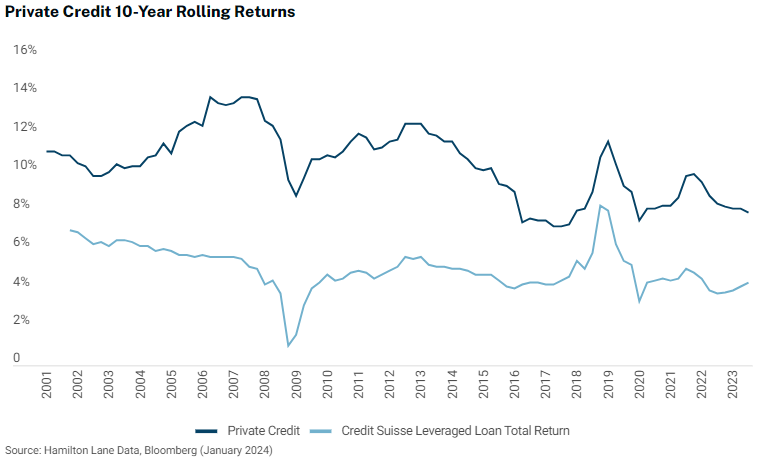
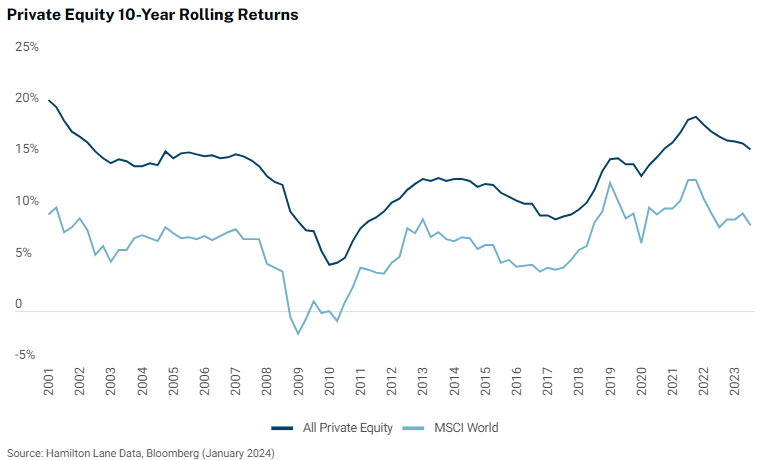
Hamilton Lane published a good note about building a robust private markets portfolio. It shares many of our views about why high-net-worth portfolios should move from 3% allocations to private markets to closer to an institutional ~25%, including diversification and a declining number of public companies for investors to choose from. More persuasive are the return benchmarks, which show global Private Equity easily outpacing world stock markets and Private Credit comfortably exceeding their closest analog, leveraged loans.
The note goes on to spell out the key factors that need to be managed when building a private markets portfolio, including:
We agree wholeheartedly, and that’s why Gridline has been transparent about not overpromising and underdelivering on liquidity, simplified call schedules for underlying investors, and assembled an investment team focused on sourcing the most compelling private market opportunities. Because that team gets to tap into Hamilton Lane’s Cobalt database, we get insight into many of the same opportunities Hamilton Lane focuses on. However, we would add two complexities investors have to manage that went under-discussed in the article.
The first is investment minimums, which can prove especially challenging to meet for those looking to access top-performing flagship funds rather than made-for-retail funds with different deals. The second is accessing performance and tax information, which can prove cumbersome for an industry that typically provides reporting updates via emailed PDF. We’ve worked hard to solve both problems with minimums ranging from $50K to $250K (due over several years) and consolidated tax and performance reporting.
If now is the time to reexamine your portfolio allocation, I’d be happy to walk through the opportunities available on the platform today.
-Charles Patton, Director, Investments
To view and download full details of the funds on our platform and in future emails like these, visit app.gridline.co/signup and answer a few quick questions that allow us to verify your identity and learn about your allocation strategy. There is no cost or commitment to create an account on Gridline.
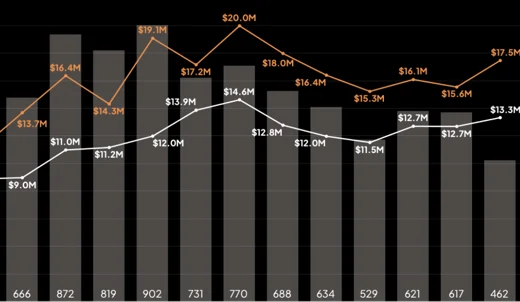
Carta consolidated insights from their expansive dataset to enable informed decisions and illuminate market conditions. Read more.
Michael Sonnenfeldt, the founder of Tiger 21, appeared on CNBC last week to discuss “Where the Super Rich is Investing.” He speaks to insights from the global ultra-high-net-worth networking group’s latest Asset Allocation Report.
A few takeaways:
We see these trends reflected in the investment patterns of ultra-high-net-worth investors who leverage Gridline to build their own high-performing portfolios.
But it’s not just the super-rich.
Accredited investors, whether directly or via their investment advisors, are leveraging Gridline Thematic Funds to build portfolios that resemble those of more substantially capitalized investors.
– The Team at Gridline
The outlook for private equity (PE) and venture capital (VC) sectors is heading towards a significant recovery, with predictions suggesting that fundraising will match the highs of 2021 by 2028. Despite the initial skepticism due to current macroeconomic and geopolitical climates, there are compelling reasons to believe in the feasibility of such growth.
Key to this optimistic forecast is the expected surge in nominal GDP, which the White House projects to be about 38% higher in 2028 than in 2021. This economic expansion lays a robust groundwork for the continued evolution and democratization of private markets, enabling the deployment of larger capital volumes more efficiently.
Additionally, the penetration of private investments into high-net-worth portfolios is anticipated to grow, with Bain forecasting a 12% annual increase in exposure to alternative investments. This shift reflects a broader acceptance and reliance on private markets for portfolio diversification and enhanced returns.
As we look towards 2028, the PE & VC sectors are poised not only to recover to their pre-pandemic levels but also to capitalize on the growing investor confidence in private markets. Integrating alternative assets into investment strategies is becoming increasingly mainstream and underscores the significant potential for growth and transformation in the private markets over the coming years.
-Logan Henderson, CEO
To view and download full details of the funds on our platform and in future emails like these, visit app.gridline.co/signup and answer a few quick questions that allow us to verify your identity and learn about your allocation strategy. There is no cost or commitment to create an account on Gridline.

In our most recent blog by Gridline investment team member Charles Patton, we explore the history and future opportunities of cybersecurity. Read More.
A fresh year brings a chance to step back and consider how the investing landscape might shift in 2024. One reliable source for clues on the year ahead is the annual reports by economists and professionals at investment houses throughout the country. While we find all their reports useful, oftentimes, the best insights come from understanding what’s just occurred in more detail.
To that end, we’ve read through annual outlooks from Preqin (abridged), Apollo, KKR, and Cambridge Associates. We’ve selected our favorite chart from each, alongside an explanation of why it influenced our thinking. The common thread across buyout, venture, private credit, and real assets is an expectation that 2024 hews closer to the mean than the extremes of the past several years.
We look forward to bringing similar insights across asset classes at a quarterly clip to highlight interesting insights we find across the private markets ecosystem and welcome your feedback as 2024 awaits.
-Logan Henderson, CEO
To view and download full details of the funds on our platform and in future emails like these, visit app.gridline.co/signup and answer a few quick questions that allow us to verify your identity and learn about your allocation strategy. There is no cost or commitment to create an account on Gridline.

The demand for private credit strategies is growing, and it’s vital to understand how investments in private credit are positioned. Read more.
Fortune journalist, Jessica Mathews, featured a prediction from Logan in the 2024 Crystal Ball edition of Term Sheet last week.
The week-long series features 2024 predictions and potential shifts and shake-ups in the private markets according to investors and founders across the technology and capital ecosystem.
Logan’s perspective underscores the importance of integrity and transparency in the evolving landscape of private market investing.
– The Team at Gridline
Happy holidays! I’m Charles, taking over for Logan in this edition of our newsletter. We wanted to take this opportunity to review our 2023 predictions and grade our predictive performance. We think we did a pretty good job, given that 2023 was a volatile year for investing, but we’ll let you be the judge.
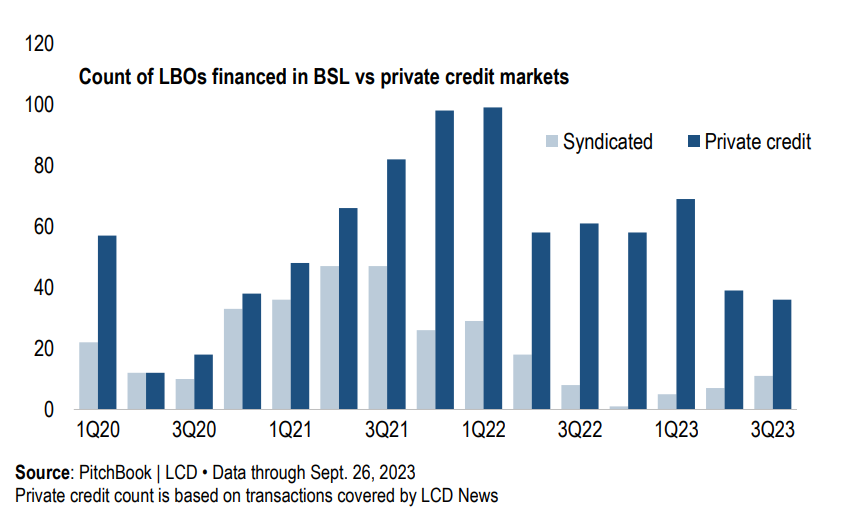
In January of last year, the writing was on the wall that banks were not going to be able to extend the type of credit that they did in the lower rate environment of 2020-2022. The collapse of Silicon Valley Bank, Signature, and other mid-sized banks accelerated this trend. This meant that every surviving bank smaller than the behemoths focused on shoring up their own balance sheets rather than lending more aggressively. The best data on this comes from PitchBook LCD, which tracks loans used to fund buyouts from private credit and the syndicated markets preferred by banks. Their Q3 update showed that the gap between buyouts financed by private credit and syndicated loans was at its widest point ever in 2023, and their figures likely understate the extent of the transition as they only track larger deals.
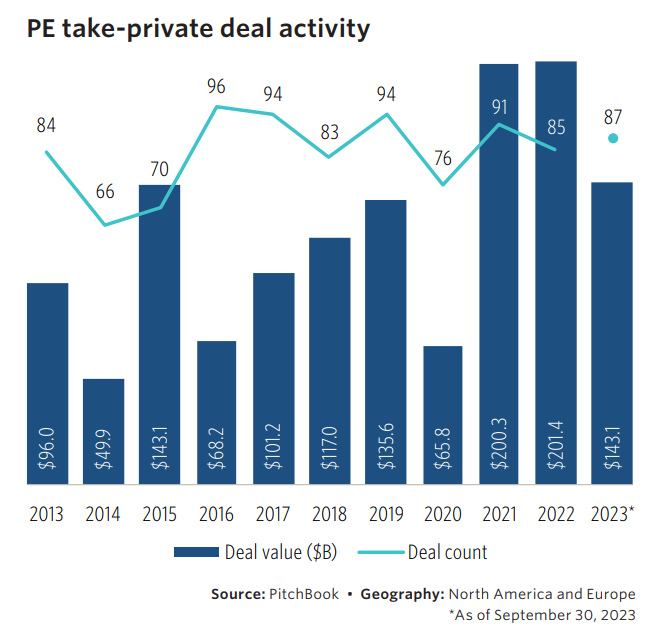
Take-private transactions in 2023 are even with 2022’s figures through 3 quarters by count and running a bit behind on dollars (numbers courtesy of PitchBook). That’s because deals in 2023 were slightly smaller than the past couple of years, a trend that accelerated in Q3 as 2/3rds of take privates were under $1B against a long-term average of 55%. Large take privates have not disappeared, though, evidenced by deals over $10B for Toshiba, Worldpay, and Qualtrics.
Sponsor acquisitions held steady in 2023 per PitchBook at 44% of exits, as corporate buyers continued to snap up PE-backed firms rapidly. Our rationale for sponsor-led acquisitions was sound, though, as the IPO markets remained largely closed, and only 1% of exits were to the public markets.
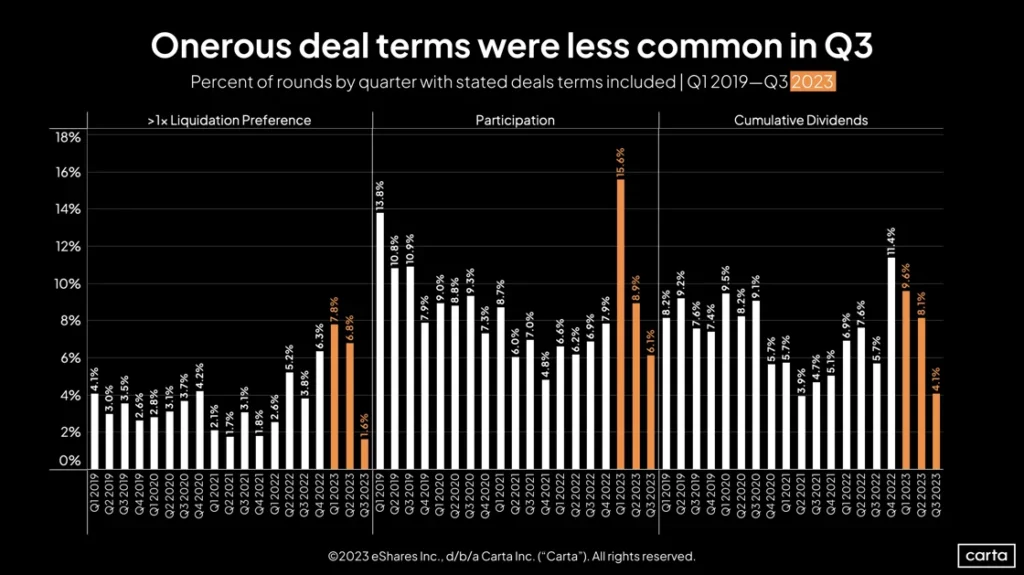
The best data source here is Carta, which publishes a quarterly report on venture trends using the proprietary data they have on over 41,000 venture-backed firms. The graph below shows the percentage of deals in a given quarter that included three common protection provisions: a liquidation preference, participation, and cumulative dividends. All three effectively allow venture capitalists to capture more of the value from a company’s exit if that exit is less than a home run. These terms either reached or neared cyclical highs in the first quarter of this year, a sign that venture investors were interested in protecting their downside. Founders were willing to accept them because they wanted to avoid a drop in headline valuations, though as the year wore on, more founders became willing to accept a lower valuation rather than load up the deal with protection provisions. The numbers below likely understate the extent of the shift, as the later-stage deals that more often include protection provisions were less common while early-stage deals held steady.
The headwinds definitely came for real assets in 2023 in the form of higher interest rates, which sent home sales tumbling to post-financial crisis era lows. This had a knock-on effect on private real assets fundraising, which followed a bumper year in 2022 with “the worst fundraising market in a decade.” The strategic opportunities in the space have indeed opened up, as areas like industrial outdoor storage and cell towers continue to see healthy demand.
In January, we will publish our quarterly outlook for Q1 2024. Until then, have a safe and happy holiday from everyone here at Gridline.
-Charles Patton, Investment Team
To view and download full details of the funds on our platform and in future emails like these, visit app.gridline.co/signup and answer a few quick questions that allow us to verify your identity and learn about your allocation strategy. There is no cost or commitment to create an account on Gridline.

Discover GP Stakes Investing: a unique blend of growth and stability for private market investors. Dive further into this innovative strategy with Gridline’s insights. Read more.
This past year, our engineering team rolled out dozens of innovations that improve private market investing.
These include features that provide greater portfolio transparency, like our Fund Activity View, as well as innovations that our investors don’t always see, like automated fund administration. Together, this allows us to create a world-class investor experience along with industry-low fees and minimums.
A perfect example of the streamlined investing experience we’ve created is that in 2023, on average, it took investors just 4 minutes to complete an investment from start to finish, including receiving funding instructions.
We look forward to continuing to deliver on our mission of delivering an unparalleled private market investing experience in 2024.
– Peter Bilali, VP Platform