
Over the course of this year, we’ve added a variety of new features to the Gridline platform as we continue on our mission to add efficiency and transparency to private market investing. Here are just a few of our favorites:
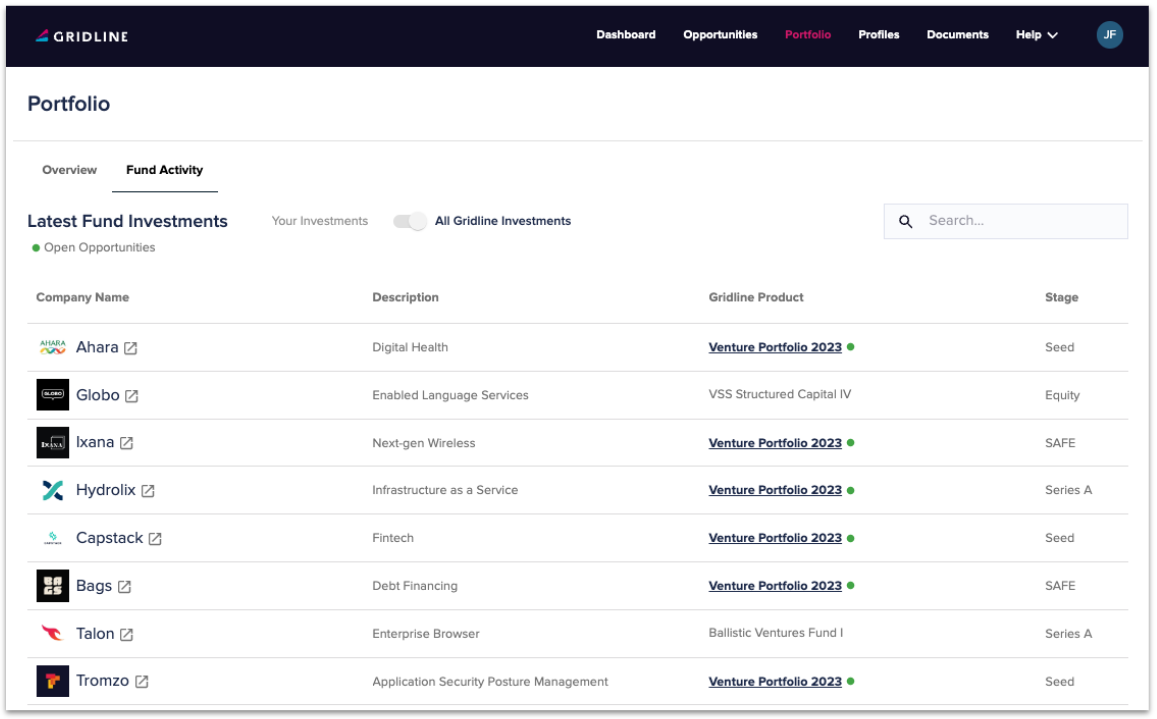
See all of the individual companies that your dollars are invested in. Haven’t invested yet? You can still see all portfolio companies across the funds currently and previously available on the Gridline platform.
Quickly and easily create and invest from a self-directed IRA with our integration to Equity Trust. You can both open and fund your account straight from the Gridline platform, either before investing or while creating your investment.

See a comprehensive list of all fund managers that Gridline is working with, including those previously listed for investing. This view allows you to explore the full catalog of opportunities, including managers who are only available in our Portfolio products or managers who may not be in the market currently but are likely to come back onto the platform with their next fundraiser.
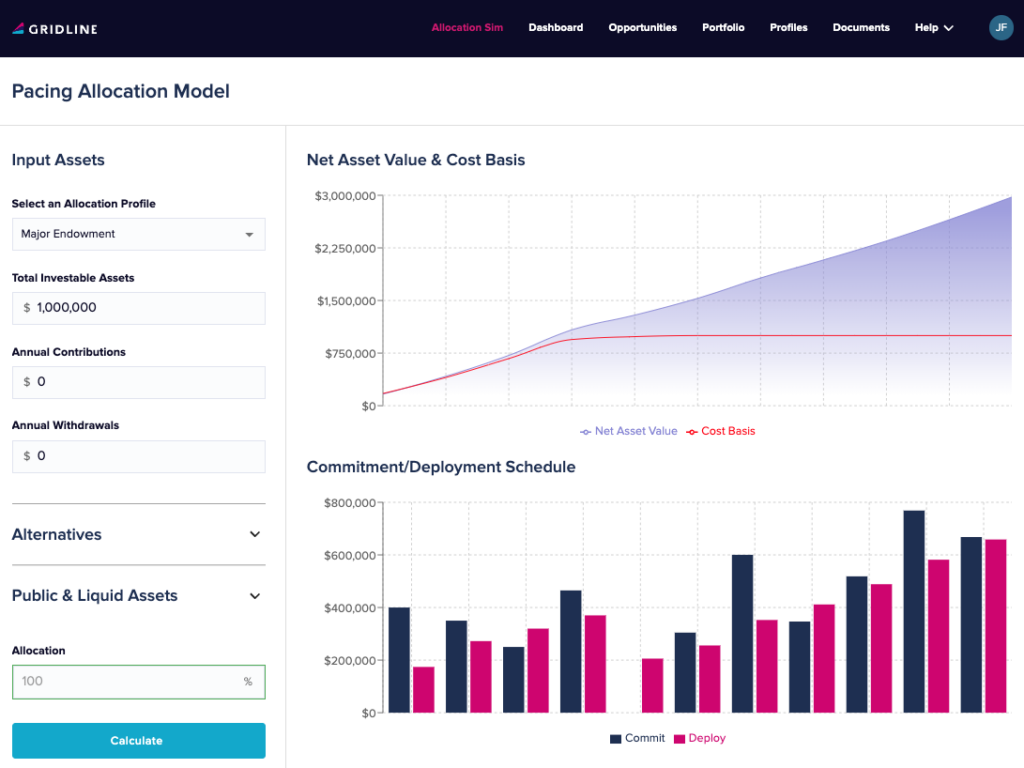
Understanding pacing and commitments across an entire portfolio can be challenging, but soon, you’ll be able to visualize commitments, cash flow, and projected portfolio growth with our new Allocation Simulator.
Gridline’s turnkey solution provides a range of features designed to simplify the launch and management of your own custom fund. From KYC to K-1, we provide a superior investing experience for you and your clients.
Book a time to speak with a member of our team to learn more, or sign up in minutes to gain access to the platform.
The private equity industry is around half a century old, while buyouts are as old as capitalism. Today, alternative investments have become an essential part of the portfolio for many institutional investors.
Many investors stick to old-fashioned paper-based processes when making these types of investments. For both investors and RIAs, however, there are many benefits to be gained by digitizing the process.
Gridline’s innovative platform overcomes many legacy challenges of investing in alternatives by digitizing the process, including discovery, subscription, administration, and reporting. The platform provides access to a curated list of investment opportunities and reduces the administrative burden associated with investing in alternatives.
Private equity funds have a long road to closing, with numerous forms and documents that have to be completed. Fundraising and closing include marketing the fund, term negotiation, initial closing, and additional closings.
For investors, too, the process is often manual and paper-based, requiring the completion of multiple forms. This can be a time-consuming process.
With Gridline’s platform, investors can complete their profile once, using it across all investments. This includes auto-populated subscription agreements and digital signing. This makes it easier and faster to close an investment.
As an Institutional Investor report puts it, “private equity is notoriously opaque.”
This can make it difficult for investors to keep track of their investments and performance. Tax management is another complex area that is constantly changing. New proposals would bring about surtaxes for wealthy individuals, changes to the taxation of carried interests, changes to net investment income tax, and more.
With Gridline’s platform, investments are centralized in a unified dashboard. This provides investors with accurate performance reporting and treasury and tax management over the fund’s lifecycle. For RIAs, the native Gridline reporting platform provides a clean, templatized view of your clients’ funded and unfunded commitments, asset class allocations, and their investment value (NAV) at any given time. This is easily distributable to your clients.
Fund administration is a complex and time-consuming task. A veritable alphabet soup of regulatory agencies has a say in how funds are offered, from the SEC to FINRA to the CFTC. Then there are the compliance requirements, which can be onerous.
Gridline’s platform considers all of this and provides a complete fund administration platform that includes KYC and AML checks, which are legally required for most financial institutions. The platform’s payment facilitation includes unique account numbers that automatically track the transfer’s processing status, post a ledger entry when the transfer settles, and reconcile account balances.
In addition, Gridline’s platform implements double-entry accounting for each investment and creates a capital account balance upon signing the investment. The system leverages a tree-based hierarchy whereby each investor has their ledger with account balances automatically aggregated up to the total funds capital account. This makes it easy for investors to see their investment value (NAV) at any time.
Gridline’s platform provides many benefits for both investors and RIAs when it comes to alternative investments. The platform makes it easier and faster to close an investment, provides accurate performance reporting, simplifies fund administration, and more.
While old-school processes may have been enough in the past, today’s investors need a more modern solution that can keep up with the pace of change. Gridline’s platform is designed for the future of investing.
Investors can now allocate retirement assets to top-performing private market funds through Gridline multi-manager portfolio vehicles, the most efficient mechanism for achieving diversification in the alternatives market.
Through a partnership with Millennium Trust Company, Gridline can increase retirement portfolio diversification and reduce portfolio risk by expanding allocations to alternative assets, including Buyout and Venture Capital, asset classes that have historically outperformed public markets.
Today, most Employee Retirement Income Security Act (ERISA) money is effectively going into passive ETF strategies deployed across the public equity and fixed income marketplace. This drives a constant bid into historically over-inflated public markets, with asset values fueled by a long-term low-interest bull market run and a rise in corporate buybacks of stock.
Over-concentrating a retirement portfolio with any one asset class, sector, or region exposes investors to greater market volatility and the potential for larger losses. Individuals nearing retirement age are especially vulnerable to market downturns, as they have less time to recoup their losses.
Actively managed private equity funds align with the strategy of retirement investing. They have historically higher returns than public markets. VC fund of funds have consistently outperformed the S&P 500 and Russell 2000 PMEs, and private equity funds generated an extra 83 cents per dollar invested compared to the public markets.
Sophisticated endowments and family offices have outperformed traditional benchmarks for decades by augmenting portfolios with access-constrained alternative assets. The advantage these institutional investors have over Main Street investors is a long-term view of investing.
Private market investments often come with a lock-up period of up to ten to twelve years, though disbursements can begin as early as year five or six. Retirement funds are already inherently illiquid, so benefit from expansion to asset classes that include an illiquidity premium – the higher return investors expect to earn for an illiquid asset.
The longer time horizon of retirement investing combined with the power of compounding enables retirement investors to build outperforming, diversified portfolios of best-in-class alternative fund managers, supported by Gridline’s institutional-quality selection and diligence process.
In the private equity and venture capital industries, due diligence is essential to uncovering the highest quality managers and reducing risk. After all, the top-quartile managers return more than 22% annualized returns, while the bottom-quartile barely beat inflation.
But with more than 18,000 private equity funds, it can be tough to know where to start. A few tangible principles can help guide the way, including people, performance, philosophy, and process. Four less tangible principles can also play a role in manager selection: passion, perspective, purpose, and progress.
Among various other elements, Gridline’s due diligence process focuses on these “four P’s” to identify the best possible managers for our clients. We make access to these managers available via Thematic Portfolios for a targeted investment thesis or vehicle that provides access to funds typically reserved for insiders.
When it comes to people, we want to know about the quality, depth, and experience of the fund’s investment team.
The team’s pedigree is important, but so is diversity. Studies show that diverse PE funds outperform their non-diverse counterparts. Additionally, relying solely on a star manager can be dangerous, so we also want to see a deep bench of talent. After all, emerging managers outperform established managers.
Key measures when it comes to performance include internal rate of return (IRR), multiple of invested capital (MOIC), and public market equivalent (PME).
IRR is a capital-weighted return providing a single cumulative figure that is useful for comparing different sizes and durations of investments. Unlike IRR, which measures the “when” of the return, MOIC measures the “how much” by dividing total proceeds by total capital invested. This is a key ratio for understanding how much value a manager has created.
PME compares private capital fund performance to public indices and is a useful metric for understanding whether a manager is truly adding value or if they are simply riding the wave of a bull market.
Value-creation is the primary focus of private capital, so it’s important to align with a manager who shares that philosophy. A long-term orientation toward investments and a willingness to actively work with portfolio companies are key.
Exploiting market inefficiencies is another key part of the private capital investment philosophy, so we also look for managers who deeply understand their chosen market or industry. This allows them to identify opportunities that others may miss.
A manager’s investment process should be clear, repeatable, and well-documented. A disciplined approach to research and decision-making, as well as a focus on continuous improvement, is vital.
Additionally, it’s important to know how positions or themes are added to the portfolio, monitored, and removed. A good investment process will help ensure that the portfolio is well-constructed and managed to minimize risk.
In addition to the four key principles of people, performance, philosophy, and process, four intangible factors can also play a role in manager selection: passion, perspective, purpose, and progress.
Passionate managers are those who are truly dedicated to their work and have a genuine interest in making a difference. They should also be able to articulate their vision for the future and inspire others to buy into it. Diversity of perspective is also important to avoid groupthink and generate new ideas. That’s why we look for open-minded managers embracing diverse views.
Private capital managers should have a clear purpose beyond simply making money. They should be motivated by creating value and positively impacting the world. Finally, we want to see evidence of progress.
Gridline’s due diligence process includes these “four P’s” to identify the best possible managers for our clients. This allows our clients to invest confidently, knowing they are aligned with some of the top talents in the industry.
John Bogle, the founder of Vanguard, has been called “the father of indexing.” In 1976, he launched the Vanguard 500 Index Fund, which tracked the performance of the Standard & Poor’s 500 Index.
This was a revolutionary idea at the time. Before this, most investors only had access to mutual funds that fund managers actively managed. These funds typically came with high fees and didn’t always perform as well as their benchmark indices.
Bogle realized he could offer investors a low-cost way to get diversified exposure to the equity market. With the launch of the Vanguard 500 Index Fund, Bogle disrupted the mutual fund industry. He showed that offering investors a better product at a lower cost was possible. And in doing so, he helped make investing more accessible for everyone.
Today, Vanguard is one of the largest asset managers in the world, with over $7 trillion in assets under management. The company offers various products, including index and exchange-traded funds (ETFs).
Economists admit that the rampant inflation of the past year isn’t transitory, and it’s possible we haven’t seen the worst. This has renewed a flight to private markets where investors seek assets that can protect their purchasing power and generate real returns.
But it’s not just inflation driving this move into private markets. Even with interest rates rising from historically low levels, they still provide extremely low returns. This means that investors are searching for yield in other places.
Private equity, real estate, and other illiquid assets have historically outperformed public markets. For example, over the past two decades, annual leveraged buyout returns outpaced global equities by more than 10 percent on average.
Institutional investors have been allocating more of their portfolios to private markets in recent years as they seek higher returns. As individual investors become more sophisticated, they’re also starting to allocate more of their assets to alternatives.
However, investing in private markets has traditionally been difficult for individuals. The process is often convoluted and time-consuming. And because these assets are not traded on public exchanges, they can be difficult to value.
Moreover, minimum contributions for private equity and real estate funds can be quite high. For example, some private equity funds have minimums of $25 million or more. This effectively shuts out many individual investors from these types of opportunities. Further, considering the importance of diversifying across funds, these high minimums limit an investor’s ability to build a diversified portfolio.
Gridline was founded to make alternative investments more accessible for everyone. The company has created a platform that allows investors to discover, track, and invest in private equity, venture capital, and other alternative assets.
Gridline has also digitized the process, from sourcing deals to investment committee approval. This streamlines the process and makes it much easier for potential investors to get involved.
But perhaps most importantly, Gridline has lowered the minimum contribution requirements for many of its funds. This enables a wider range of investors to access these assets. And because Gridline offers a diverse selection of funds, investors can build a well-diversified portfolio without committing a large amount of capital.
In many ways, Gridline is following in Vanguard’s footsteps. Like Vanguard, Gridline is focused on making investing more accessible for everyone. And by offering a better product at a lower cost, Gridline is changing the investing landscape.
Try out Gridline today and see how easy investing in private markets can be.
Alternative investments, like venture capital and private equity, have been around for decades. But the process for investing in these assets is still incredibly antiquated.
The first step, sourcing deals, is often done through personal relationships and networking. Once a potential deal is found, a non-disclosure agreement (NDA) must be signed to access the investment materials. Then, the due diligence process begins.
This is where things can get really cumbersome. Potential investors must fax over their subscription agreement and personal information to the fund manager. A first-round bid or non-binding term sheet is then drafted and sent back to the potential investor.
Once further due diligence is completed and both parties are happy with the deal, a preliminary investment memorandum (PIM) is sent out. If the potential investor wants to move forward, they must then engage a lawyer to review the PIM.
The final step is investment committee approval, after which wire instructions are sent out to the investor. The entire process is still done manually and is incredibly time-consuming. It’s not uncommon for the whole process to take months or even years.
But things are finally changing. A number of startups are working on making the alternative investment process more efficient and modern. Gridline has developed an online platform that allows investors to access alternative investments, including private equity, with a few clicks.
While it will still take some time for the industry to catch up, it’s clear that the days of faxing over subscription agreements and personal information are numbered.
The legacy approach to alternative investing is cumbersome, time-consuming, and outdated, which limits many individuals’ ability to access these types of assets.
Gridline has developed an online platform that makes it easy for investors to discover, track and invest in alternative assets. The platform is simple and intuitive and allows investors to quickly register and deploy capital.
Gridline has also digitized the entire process, from sourcing deals to investment committee approval. This streamlines the process and makes it much easier for potential investors to get involved.
The future of alternative investing is digital, efficient, and open to everyone. With Gridline, gone are the days of faxing over documents and waiting months for a deal to go through.
We’ve written about the many benefits of alternative investments, but one of the biggest is the potential for high returns. Private markets have significantly outperformed public markets for the past two decades, and investors are taking notice. In 2021, global private equity fundraising hit a record $733 billion, and 2022 is on pace to exceed that.
Institutional investors are allocating more of their portfolios to private equity, real estate, and other illiquid assets as they chase higher returns. And it’s not just pension funds and endowments; even insurance companies and sovereign wealth funds are getting in on the action. Not only that, but alternative assets like venture capital have a low correlation to traditional asset classes, providing much-needed diversification.
In a world with rampant inflation, low-interest rates, and political uncertainty, alternative investments offer a unique opportunity to generate real returns. So it’s no wonder that they’re becoming more popular every day.
However, accessing these types of investments has been difficult, if not impossible, for many individuals. This is where Gridline comes in. By making alternative investing more efficient and accessible, we’re opening up these types of assets to a wider range of investors.
This democratization of access to alternative investments has the potential to change the landscape of investing, and we’re excited to be at the forefront of this shift.
If you are considering investing in the private markets, your options to access alternatives are either SPV’s and rolling funds or actively managed funds.
SPVs and rolling funds make money even if the underlying investments aren’t successful, so they often focus on access to deals, and not on ensuring the underlying investments have a positive outcome once capital is deployed.
Our focus at Gridline is on top-quartile, actively managed funds with highly involved fund managers and general partners. Traditionally this kind of financial product can become expensive, with layers of fees offsetting their gains. Gridline’s fee structure allows investors to keep more of the returns in their own pockets.
A traditional fund of funds typically layers at least a 1% management fee and 10% carry on top of the underlying fund’s 2% and 20% fee.
Banks and wirehouses often add yet another wealth management or advisory fee on top, resulting in a 20% to 30% total cost over the life of the investment. There’s too many fingers in the cookie jar for the investor to win in the end.
At Gridline, we charge a simple, AUM-only fee with a tiered structure, much like you’d see from a mid-size RIA. We charge 50 to 100 basis points decreasing based on their total AUM with Gridline. Our fund investments have zero carried interest which ultimately helps us generate better net returns for our users.
When you look around at the universe of investment opportunities, it becomes clear that private markets are broken.
The market for alternatives — things like venture capital, private equity, real estate and crypto — is booming, with more than $5 trillion expected to come into this market over the next four years. It’s further proof that the traditional 60/40 portfolio allocation model doesn’t work anymore with yields low and public equities hitting all-time highs. Generating the returns investors are used to requires taking on more risk, driving all this attention in alternative asset classes.
But there’s one problem.
While public markets are more accessible than ever — with social media and fee-free trades attracting a whole new generation of investors — private markets remain closed off, even to high net worth individuals. Supply and demand is concentrated among a select group of insiders.
We built Gridline to solve these persistent inefficiencies. We want to help individuals invest like the most successful endowments and family offices that are using alternative investments to generate excess returns. Big endowments like Yale put as much as 60% of their portfolio in alternatives and are reaping the benefits as a result of having exposure to diversified, non-correlated assets.
The problem isn’t just on the investor side. Emerging and even established fund managers are spending weeks and months — as much as a third of the time they’re raising capital — just identifying potential investors. Even the largest global funds struggle with how to bring retail investors into the fold and diversify the contribution base.
Those investors are out there, but they’re stuck on the sidelines waiting for an invite.
What alternatives have been clamoring for is a matchmaker, that connective tissue that brings investors who aren’t experiencing the returns they want and alternative asset managers who need a bigger audience together in a unified marketplace. Gridline achieves this by providing access to an expertly curated set of funds while leveraging technology to streamline the often cumbersome process of investing in alternatives.
We’re strong believers in the power of actively managed funds. The alternative investment landscape has seen a lot of focus on investments in individual companies or things like one-off real estate deals. But we’ve worked with great advisors and capital allocators and know the added value they can bring in turning a good company into a great business over time.
That’s why we’re starting with venture capital funds that we’ve picked based on a comprehensive selection criteria, with a bent toward managers with results verified by empirical evidence and a vested ownership in their funds’ success. These are not people spinning up an SPV to capture the upside with none of the downside risk — their livelihood depends on the success of the total fund and their investors get that benefit. Our users will be able to access these funds — which traditionally required as much as $1 million in liquidity — with minimums as low as $100,000. We’re keeping our fees low, charging an AUM fee that ranges from 0.5%-1.0% on invested capital.
The financial products themselves are only part of the problem we’re addressing. We’re also building industry-leading technology to improve the “rails” that make investing in these asset classes challenging. We’ve seen this kind of transformation in areas where offline, manual financial processes have been replaced by fintech applications in payments, lending and other banking services.
In alternatives, there’s a lot of messy back-end processes like investor questionnaires, KYC, treasury management, capital calls and tax reporting that can all be done digitally. We’re automating and leveraging technology to make that part as easy as executing a trade in the public markets online.
Tackling both sets of challenges I’ve described opens up private markets to a whole new set of investors. Investing in these asset classes today is out of reach for far too many and we’re excited to be building a future where everyone can have access to endowment-style investing and reap the superior returns it offers.
Put simply, we are building a platform that enables individual investors to emulate what the smartest investors in the world are doing with their portfolios. Our platform provides individuals the ability to discover and build a highly diversified alternative asset portfolio while concurrently expanding the pool of investors funds can leverage … we hope you join us on this journey.
Alternative investments have historically operated in an opaque marketplace. It’s hard to get access and it can be just as difficult to perform due diligence. Tack on excessive fees pervasive in private markets and it can be difficult to succeed as an investor in private markets.
Transparency is one of the central values we built Gridline on and it’s a key way we ensure our customers are as successful. We are a trusted advisor that provides access to sound investments. We’re doing this in two key ways: Our fund selection process and our simple fee structure.
Our fund manager selection process is rigorous, mixing elements of art and science to ensure our users are successful. We break this process down into our four Ps: Performance, People, Process and Philosophy. These four principles mix qualitative and quantitative measures to sort the managers who have true skill from those who may have just gotten lucky.
Once we make our selections, we are transparent in passing our findings onto users. Every opportunity within Gridline’s marketplace provides key pieces of information to give users a comprehensive view of risks each opportunity.
This includes a traditional “tear sheet” with key details on the fund’s team, investment thesis and past performance.
As a registered investment advisor ourselves, we act in your best interest. Part of that is providing the Gridline Perspective on each investment. This perspective is a synopsis of what went into making sure the evaluation process is robust and unbiased, why our experts think this is a sound investment and our take on what gives the fund’s team a unique edge.
Opening up the world of alternative investments to a wider swath of investors is exciting.
This is a space where a home run can mean huge returns. Individual investors now have the opportunity to allocate capital like the most sophisticated institutions. But often we see main street investors paired with the riskiest deals that have little oversight once their money is deployed.
Investing in alternative assets, like a venture capital fund, is a little more complex than just buying a stock or even a mutual fund. Picking winning companies is only half of what good fund managers do. They spend as much — or more — time nurturing these investments to ensure they’re successful.
That’s why picking actively managed funds — and, by extension, the fund manager — are so critical in this arena. Passive SPVs and rolling funds may provide access to interesting deals but they are by nature less engaged in ensuring the underlying investments are successful once the capital is deployed.
These kinds of investment vehicles can easily make money just on the management fees, but lose nothing when the underlying investments fail. You may want to pause a bit when you see these opportunities announced with rocket sign emojis. Fund managers should be key advisors to the companies they invest in, providing expertise and value to help everyone come out a winner.
The selection component of a manager’s job isn’t easy, either. Consider for a moment the difference in the options available between the more efficient public markets — where data on every company is readily available — and opaque private markets. Mutual funds may have to pick from a few thousand securities while the options available to venture capitalists is the universe of a half-million private companies.
Skill matters here and it’s easy to make a misstep. Manager dispersion bears this out, showing that the difference between top and bottom-quartile managers is more than 7.5 times greater in private markets. Top managers in private equity beat even the average manager by two times.
Managing a fund is difficult work that requires real skill. How do you avoid the duds and pick one that maximizes your return? Gridline takes this job seriously, performing extensive due diligence on every fund we invest in and offer to our users. We’ve broken down our process into four principles, the four Ps.
Everything we do at Gridline is focused on maximizing returns for our members. This includes our selection process, which ensures you have access to managers who can pick sound investments and actively manage those companies to produce returns that beat the public markets.