
Crowdfunding was popularized by platforms like GoFundMe and Kickstarter, which allow individual donors to make small donations towards a cause. Equity crowdfunding takes this concept one step further, allowing anyone to invest in private companies.
Equity crowdfunding is a relatively new way for businesses to raise funds from a large group of investors. The first US-based equity crowdfunding platform was ProFounder, which launched in 2011, but later shut down due to regulatory issues. It wasn’t until the JOBS Act was passed in 2012 that equity crowdfunding became viable.
But what’s the difference between equity crowdfunding and venture capital? While the two concepts are similar in many regards, there are key differences to keep in mind.
A Chicago Booth report highlights that out of a sample of 367 equity crowdfunding offerings, only a single one (0.2%) exited—with a mere 2.5X return. In comparison, an analysis of over 1,000 startups funded by venture capitalists found that 22 percent exited, and 1 percent reached valuations of over $1 billion.
In other words, venture capital has a far higher success rate than equity crowdfunding. The main reason for this is that equity crowdfunding platforms are often the last resort for businesses that can’t get VC funding. That’s a red flag because it means the company likely doesn’t have the financials or potential for success to convince venture capitalists.
The data backs this up, with the same Chicago Booth report highlighting that firms that sought crowdfunding were less profitable and carried more debt than those that got venture capital.
Another difference is that venture capitalists are experienced professionals who make well-informed decisions about which companies to invest in. They do extensive due diligence on a company before investing and have the resources to provide support if needed.
In contrast, equity crowdfunding investors often have limited knowledge or experience in assessing investments, making it more likely that their decisions will not result in success.
An analysis of crowdfunding fraud published by the Association of Certified Financial Crime Specialists (ACFCS) highlights that fraudsters often use crowdfunding platforms to launder money and defraud investors.
Since crowdfunding is open to more people, it’s easier for scammers to slip under the radar and solicit investments without going through the same rigorous due diligence process as venture capitalists.
Venture capitalists use a thorough process to screen investments, making it more difficult for fraudsters to get their money. This does not mean that venture capitalists are immune from investing in fraudulent businesses, but their process makes it much less likely.
Accredited investors have many avenues today to invest in private companies. These investments are reserved for high-net-worth, high-earning, or well-educated individuals who have been deemed to have the financial sophistication or experience to understand the risks associated with investing.
In contrast, retail investors make up the majority of equity crowdfunding investors. They are typically not required to meet any criteria and are allowed to invest regardless of their education, income, or net worth. Equity crowdfunding is a more accessible way for everyday investors to get involved in private investments.
That said, retail investors get paired with businesses that are likely less successful and riskier than those receiving venture capital.
Equity crowdfunding and venture capital have similar goals—to finance businesses in exchange for a share of their profits. However, they differ in terms of their risk profiles, the types of investors involved, and the success rates of their investments.
Venture capital has a higher success rate, is often used by experienced investors, and involves a rigorous due diligence process. Equity crowdfunding is more accessible to retail investors, carries a higher risk of fraud, and has much lower odds of achieving successful exits.
Much is said about “recession-proof” portfolios, but few investors left 2022 unscathed. Instead of being a rebound year, 2023 is expected to be another year of volatility and uncertainty. This means investors must look for creative ways to diversify their portfolios and build resilience in economic downturns. Private markets—such as venture capital, private equity, and private debt—may offer a compelling solution.
Historically, private markets outperform in recessions, but there’s more that investors can do to create a recession-resistant portfolio. Let’s explore a few strategies.
Most sectors saw a dramatic fall in venture funding in the second half of 2022, but this wasn’t true for industries like ClimateTech. This sector saw a massive influx of capital and is expected to remain strong throughout the economic recession. This is due primarily to the fact that investments in ClimateTech can help protect against long-term economic damage from a hotter planet.
Further, the new US climate bill has made it much easier for ClimateTech startups to get off the ground. It provides a $370 billion funding package with incentives for solar and wind power and emerging technologies such as direct air capture and long-duration energy storage. Venture capitalists used to backing software companies now need to get up to speed on ClimateTech.
Another sector that’s becoming indispensable to businesses is cyber security. The sector is proving recession-proof, with M&A and fundraising activity up 60 percent and 22 percent, respectively, in the first three quarters of 2022. Private equity actively backs vendors engaged in platform consolidation, driving sustained deal activity.
The cyber security sector is set to surpass pre-coronavirus levels regarding deal activity and value. In the future, enterprises must continue investing in cyber defenses regardless of the economic climate to protect against a sophisticated threat landscape.
Finally, pharma is well-positioned in a recession. Clinical trial technology, digital therapeutics, and retail pharma technologies pique investors’ interest.
For instance, CVS and Walgreens are investing heavily in technologies to create more efficient operations, including de-centralized clinical trial space. Payers such as Blue Shield of California are also using technology to improve the pharmacy value chain.
Hedge funds are another area that can provide tremendous value to investors during a recession. Hedge funds can outperform the market when it’s falling, as managers use a variety of strategies to generate returns in any market condition.
For instance, long-short strategies allow managers to take a bullish position on stocks they expect to rise in value while simultaneously taking a bearish position on stocks they believe will decline. This helps mitigate losses and can even generate profits in a falling market.
Another strategy gaining traction is private credit. This involves making private loans to firms that often can’t access bank loans, often at higher interest rates. Private debt tends to be less correlated to the stock market, which can help a portfolio remain resilient in a challenging market.
These are all relatively untethered from macroeconomic conditions and could potentially yield higher returns than traditional investments.
Ultimately, investors must diversify their portfolios to weather economic downturns. Private markets offer a variety of strategies to help investors achieve this goal.
Despite the harsh macroeconomic environment, over 20 million people are set to become millionaires in the next few years. This will be no thanks to the public markets, however, as the bull market from 2009 to 2022 is unlikely to repeat.
Allianz calls the years before 2022 “the last hurrah” for the public markets, and investors looking for higher returns and more diversified portfolios are increasingly turning to the private markets.
To succeed in a more challenging investing environment, here are 10 New Year’s resolutions that could help strengthen your portfolio.
The 60-40 portfolio was the golden standard of investing for decades, but it is no longer sufficient for investors looking for higher returns. In the next decade, the S&P 500 is projected to return a mere 6% average annualized, while bond returns fail to even keep up with inflation.
In comparison, the median private equity fund returns a net IRR of 19.5%. The good news is that private markets are becoming more liquid, accessible, and with lower capital minimums than ever before. Accredited investors can now explore private markets with confidence and strengthen their portfolios.
Many investors are familiar with the concept of investing in “winners” and “losers.” The problem, of course, is that it’s impossible to know which will be which ahead of time.
Instead of gambling on a single manager, a better approach is to build a portfolio of managers across vintages. This way, you diversify your portfolio over time and increase your chances of successful investments.
First-time managers and smaller funds, in particular, have historically outperformed larger, more established funds. This is because they are often hungrier, more agile, and have greater access to deal flow–as it’s easier to find a good deal when fewer people are looking.
Passive ETFs and index funds became wildly popular in the 2010s bull market. When markets are going up, it’s easy to invest passively and make money.
But when markets become more volatile, passive investing can lead to significant losses. 2022 was a cautionary tale of this, as passive 60-40 investors lost the most money of any year in recent history.
Investors should demand that active management be part of their portfolios. This means getting behind managers who do the work to advance their portfolio companies. Active management is truly the way to reap the rewards of the private markets, and it’s part of why private funds consistently outperform public markets.
The world of alternative investing platforms has exploded in recent years, making it easier than ever for accredited investors to diversify their portfolios with alternatives.
But many investors take a “spray and pray” approach to alternatives, investing in the likes of a fractional piece of art, a luxury watch, or even a bottle of fine wine. While these individual investments may be exciting, they don’t make for a strong investing strategy.
Instead, investors should invest in a diversified portfolio of alternative assets that have meaningful real-world economic value. This could include investments in real estate, venture capital, private equity, and hedge funds.
Many investors overlook the private markets when it comes to retirement savings. They stick with stocks and bonds, unaware of the potential of private markets to generate higher returns for retirement.
Dangerously, some retirement investors become aware of the ability to invest in individual stocks, cryptocurrencies, and other speculative investments within their retirement accounts. While this may be tempting, these investments are far riskier than relying on professional managers in the private markets.
Individual investors consistently underperform market averages by a wide margin. Investing in diversified private market investments within your IRA could help you generate higher, more consistent returns and build a more secure retirement.
Investors in the private markets are all too familiar with the pain of manually tracking portfolios in spreadsheets, managing a multitude of K-1 tax forms, and reconciling them with their taxes.
It’s time to get out of the spreadsheet cycle. In 2023, you expect a great online experience in every other part of your life–the same should go for alternative investing.
Accredited investors should look for online platforms that offer a consolidated view of their entire portfolio, automated tax management, and direct access to their investments. With Gridline, investors can get all this and more.
Investors may be tempted to invest directly in individual deals instead of funds. The truth is direct investing is far more dangerous than investing through a fund. When you invest directly in a deal, you are taking on an enormous amount of risk by putting your money into an illiquid asset with no diversification.
It’s also important to remember that most individual deals will never hit the returns you expect. Investing in a broad portfolio of funds is the only way to gain real diversification and potentially generate higher returns.
The United States saw an impressive bull market for over 13 years, and many investors are unaware of the risk they’re taking by not diversifying beyond U.S. borders.
There are around 6.1 million businesses in the US out of 333 million firms worldwide. Investors should diversify their portfolios to include investments in these non-U.S. markets, so they can benefit from the growth potential they offer.
Fees might not seem like a big deal, but they can eat away at your returns and even turn a winning investment into a mediocre one.
It’s essential to read the fine print and understand the fees associated with an investment before you commit your money. Many investors are unaware of the hidden fees, such as management fees and performance fees, that could cost significant amounts over time.
Gridline charges a management fee of just 50 to 100 basis points annually, with the fee varying based on total assets under management. This fee is well below an investor’s actual cost to evaluate and select managers. We also don’t charge carried interest.
Looking purely at a manager’s past IRR can be dangerous. It’s important to compare performance to a customized peer group of funds with similar investment styles and strategies. This allows investors to make informed decisions and select funds with the highest potential for success.
It is equally important to look at the people behind the funds, their process, and their philosophy.
Beyond performance entirely, it’s also essential to understand if a team possesses unique skills and capabilities, such as proprietary deal flow or special access to capital. Further, the team’s investment process needs to be repeatable; only then can the team generate consistent returns.
The team’s philosophy should also be consistent with a long-term outlook. Short-term speculation can often be a way to disguise the lack of excellent skills, while long-term investments are associated with better risk-reward outcomes over time.
The investing landscape changed dramatically in 2022. The extended bull market of the 2010s is unlikely to repeat, and investors need to adjust their strategies to serve them in a new investing environment.
These 10 New Year’s resolutions could help you strengthen your portfolio and make it more sustainable for the next decade and beyond. With Gridline, accredited investors can access top-quartile investments with low capital minimums, fee transparency, and greater liquidity.
Since the 1950s, the portfolio strategy known as “60/40” has been a mainstay for many investors. The idea is to put 60% of your money into stocks for long-term growth and 40% in bonds as a hedge against market declines.
But this year has been tough on the venerable strategy. Recent data from the Bank of America, reported on Investopedia, noted that “those who followed the traditional 60/40 portfolio rule have seen their annualized returns sink 34.4% this year.”
That’s the worst performance in a calendar year since the Great Depression. On an after-inflation “real” basis, it’s the worst year ever for this type of portfolio. As a New York Times article points out, many retirees forced to sell assets during the sell-off have little choice but to accept deep losses.
From 2000 to 2021, stocks and bonds were negatively correlated, owing to macroeconomic conditions like low-interest rates and low inflation. However, as with the period from 1965 to 2000, this relationship has recently broken down. Inflation is red-hot, and interest rates followed suit. This shift means that investors today can no longer rely on bonds to offset stock losses, and they’ve suffered losses in both asset classes this year.
This is because the low-interest rates that have prevailed for much of the past 14 years have led many investors to seek higher returns in riskier assets such as stocks. 40-year highs in inflation, however, forced The Federal Reserve to raise rates in an attempt to control prices. Interest rates and bonds are inversely related, meaning bond prices fall as rates go up.
The 60/40 portfolio can no longer be relied upon to deliver the same risk-adjusted returns as in the past. Investors will need to revisit their asset allocation strategies and consider how to position themselves for a new era of macroeconomic conditions.
Just because the 60/40 portfolio isn’t working like it used to doesn’t mean that diversification is a lost cause. There are still opportunities to find investments that will help mitigate risk in your portfolio.
In fact, during both the dot-com bust and the financial crisis of 2008, private equity funds had less steep drawdowns and quicker recoveries than stocks. The outperformance of private markets continues well beyond drawdowns. For instance, in the decade following the dot-com crash, the public market equivalent index’s annual return was 0.08%, while private equity returned 7.5% annualized.
More recently, hedge funds fell by 5.4% in 2022 H1, while the S&P 500 lost over 20% of its value. Top hedge fund managers could navigate the market by adequately assessing risk and making nimble decisions.
The key is to find investments that will help you weather the storms of market volatility, regardless of what happens with stocks and bonds. By diversifying your portfolio beyond the traditional 60/40 mix, you can protect yourself from losses and position yourself for long-term growth.
Gridline is one such opportunity. Gridline is a digital wealth platform that provides a curated selection of professionally managed alternative investment funds. It enables individual investors and their advisors to gain diversified exposure to non-public assets with lower capital minimums, lower fees, and greater liquidity.
Mature and mega VC firms typically don’t place early-stage bets but instead focus on companies that have already achieved some success. In other words, rather than bring new ideas to market and help them grow, these firms prefer to invest in already proven businesses. That’s where micro VCs come in.
Micro VCs are small, nimble firms focused on investing early in companies with high growth potential. Defined as funds smaller than $50- or $100 million, micro VCs play an essential role in financing and incubating new businesses. By taking on more risk, they provide critical funding at a pivotal moment in a company’s development.
By investing in seed and early-stage companies, micro VCs can achieve superior returns. While performance data specific to funds smaller than $100 million is hard to come by, a study of VC performance over 20 years provides some insight.
As Cambridge Associates data shows, return multiples have consistently been significantly higher for smaller funds. In other words, small VC firms have outperformed their larger counterparts. The physics of capital markets would indicate that this should be the case. When firms are small, they generally invest in companies earlier in their development cycle and have more room to grow.

This outperformance is also clearly seen in the net TVPI of new and developing funds by vintage year. The data shows that new and emerging funds are consistently among the top performers.

Further, as Preqin data shows, eight of the ten top-performing venture capital funds have fund sizes of $100 million or less.
Why? There are a few reasons. Beyond the physics of capital markets, smaller firms usually have a different focus and strategy than larger firms. They’re often sector-specific and deeply understand the companies in their domain. Additionally, they tend to be more founder-friendly, providing not just capital but also mentorship and resources. And because they’re often investing alongside angel investors, they’re typically more attuned to the needs of early-stage companies.
Speed is another advantage that micro VCs have over larger firms. They can move quickly to support companies that are gaining traction and need capital to scale. This agility allows them to capture opportunities that others may miss.
Several factors, including the proliferation of technology, the globalization of markets, and the rise of the entrepreneurial economy, have fueled micro VCs.
As technology has lowered the barriers to entry for starting a business, entrepreneurs have more opportunities to bring new ideas to market. At the same time, globalization has created a more level playing field, making it possible for businesses to scale quickly and reach new markets.
This environment is perfect for micro VCs, which are well suited to spotting and backing the most promising companies. And as the number of micro VCs has grown in recent years, so too has the amount of capital available for early-stage companies.
PitchBook data highlights the precipitous rise in the number of micro-funds closed annually, growing “from an average of 75 each year between 2006 and 2011, to an average of 320 each year between 2018 and 2021.”
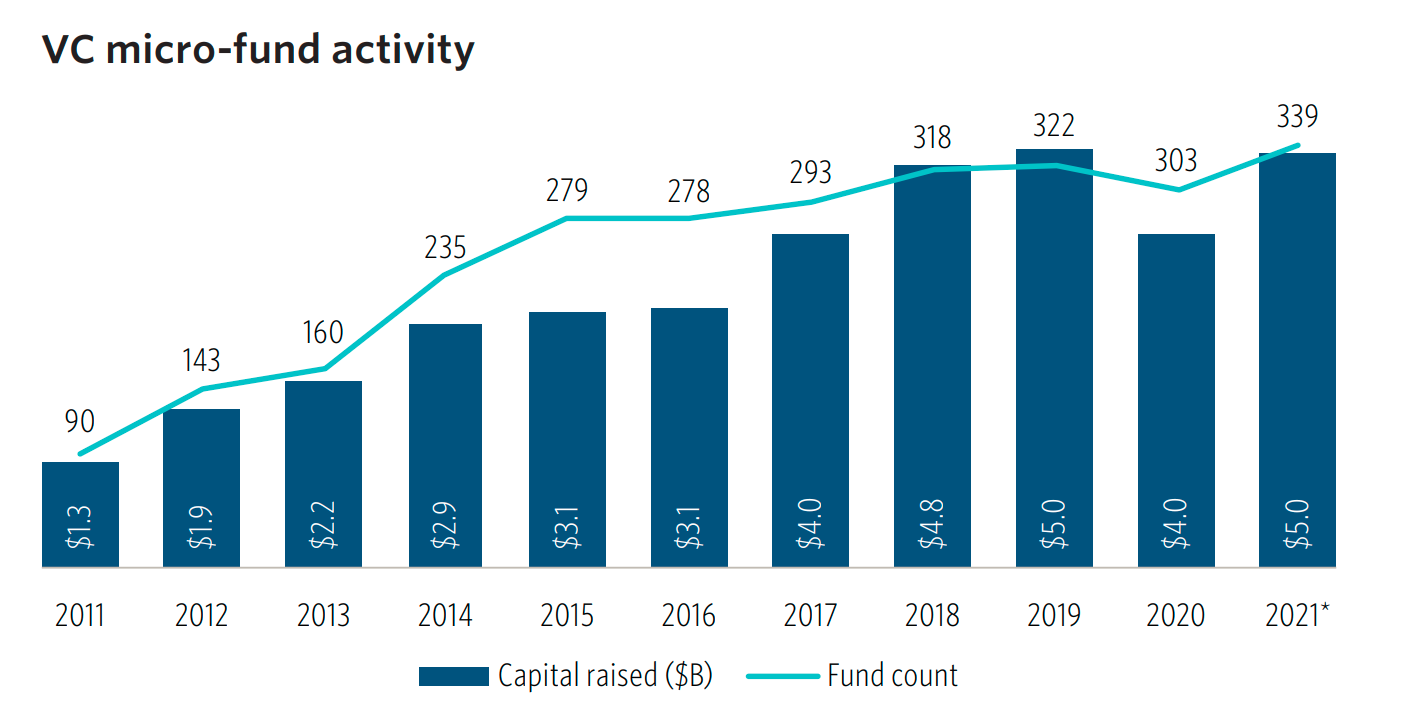
The AUM of micro VC firms has also exploded, increasing from just over $10 billion in 2011 to over $60 billion in 2021, according to the same PitchBook report.
This growth is driven by several factors, including an increase in LP interest, the rise of new micro VC firms, and the launch of funds focused on early-stage companies. As more capital flows into the space, we’ll likely see even more growth in the coming years.
The rise of micro VC is highly correlated with the rise of seed deals, and seed deals have become increasingly attractive to investors. The most obvious reason is the opportunity for spectacular returns.
Private markets have long outperformed public markets. Several arguments have been put forth to explain this outperformance.
One common explanation is that private companies are less efficiently priced due to information asymmetries between insiders and the market at large. Additionally, a liquidity premium exists in private markets, as investors are unable or unwilling to exit their positions as quickly as in public markets.
Even the short-termism of public markets plays a role in the outperformance of private companies. Public companies are pressured to deliver quarterly results, while private companies can take a longer-term view. This gives private companies a significant advantage when making strategic investments, such as research and development or long-term marketing campaigns.
But a more nuanced explanation may be that active private market managers have more opportunities to generate alpha.
Active management refers to actions taken by a manager that deviate from a passive strategy, such as security selection, market timing, or dynamic asset allocation. Active private market managers may also add value through their relationships and networks.
Preferential access to investments, greater control over portfolio composition, and the ability to take a longer-term view are all factors that may allow active private market managers to generate alpha. Good fund managers diligently pick winning companies and nurture those investments to ensure they’re successful.
The “fundamental law of active management,” which says an investor’s excess return equals skill times opportunity, separates the winners from the losers.
Manager selection is comparatively more complicated in private markets due to the lack of transparency and availability of information. At the same time, it’s also far more critical in private markets due to the wider dispersion of returns. While top-quartile private equity funds produce, on average, an incredible 30% net IRR, many bottom-quartile funds lose money. The median fund’s 19% net IRR still significantly outperforms public markets, but even better returns can be achieved.
Therefore, Gridline carefully selects managers based on several quantitative and qualitative criteria that may predict outperformance. These include, but are not limited to, past performance, a conviction in the investment thesis, preferential access to investments, and the ability to add value through portfolio construction and monitoring.
To select the best managers, Gridline relies on a combination of screening tools and due diligence conducted by our team of experts. Our screening tools help to identify managers that meet our criteria, while our due diligence process allows us to assess further a manager’s skills, capabilities, and investment process.
Rather than relying solely on the built-in liquidity premium of private markets or even the “complexity premium” associated with less efficiently priced securities, Gridline looks for managers that can generate alpha through active management. We believe this is the best way to achieve superior long-term returns for our investors.
Private markets have delivered superior returns for several reasons. Inefficiencies in pricing and liquidity premiums are among the most commonly cited explanations.
However, more significant opportunities for alpha generation may be the most critical factor. Active private market managers have several advantages, including preferential access to investments, greater control over portfolio composition, and the ability to take a longer-term view.
But manager selection is more difficult in private markets due to the lack of transparency and availability of information. Therefore, it’s essential to carefully select managers based on many criteria that may predict outperformance.
From 2008 to 2022, the world enjoyed an era of “free money.” Central banks around the globe kept interest rates at historic lows to stimulate economic growth. This greatly impacted public markets, which saw a record bull run.
These rates were generational lows and, in many cases, all-time lows. Even today’s higher interest rates are a historic anomaly in the past 670 years of data. A few years ago, analysts claimed that we had entered a “new era” of low-interest rates.
But now, the era of free money is coming to an end. The US Federal Reserve has raised rates so hard and fast that the United Nations warns of a global market crash. And even Fed officials are now talking about rates going to 4.75% by early 2023 or even as high as 5%.
The stock market has responded negatively to rising rates, and there’s no reason to think this time will be any different. Of course, the market has already entered a bear phase, but more pain is likely on the way.
Eight of 9 historical periods when the Fed raised rates have seen recessions. In today’s case, with no downturn declared, the market still has a long way to fall. Jamie Dimon, the CEO of JP Morgan, forecasts another 20% drop in the markets. This is a far cry from the “new era” of low-interest rates that analysts were calling for just a few years ago.
The end of free money also signals the end of easy money for companies. For years, companies have been able to borrow at rock-bottom rates and use that cheap debt to fund share buybacks or another financial engineering. With rates on the rise, that era is coming to an end. And without easy money to prop up earnings, companies will have to start making real profits again.
Beyond the short-term pain, the end of free money could create a new era of lower returns. As an article by The Economist puts it, younger investors can expect “dismal returns” ahead, and analysts forecast a potential “lost decade” for stocks.
In addition to the risk of a further market decline, macro risks could exacerbate the downside. Geopolitical tensions are rising, with hot spots like Russia and Ukraine and likely the China-Taiwan conflict shortly. Trade relations between the US and China are also at a low point.
Even following a sharp market correction, stock market valuations are still relatively high, as PE multiples doubled over the decade that ended on December 31, 2021. This leaves little room for error, and any further negative news, like poor earnings in 2023, could result in a rapid and significant decline.
Private equity firms have “trillions in dry powder left to spend,” even after outpacing record-setting fundraising in 2021.
As banks tighten their lending standards, private firms can provide the capital companies need to grow. And with public market valuations still high, private firms will have ample opportunity to buy assets at a discount.
Mergers and acquisitions in tech are already on the rise in the private market as investors seek to take advantage of market conditions. Historically, firms that made acquisitions during downturns significantly outperformed their peers in the following years.
Despite the challenges ahead, the end of free money presents a unique opportunity for investors in private markets. Gridline makes it easy for individual investors and advisors to get exposure to top-performing private funds. You can take advantage of market conditions and build a diversified portfolio that can weather any storm.
2022 saw the fastest rate hike cycle in decades, bringing turmoil to public and private markets. On an absolute basis, however, interest rates hovering at 4% to 5% are still low by historical standards.
In 2001, The Federal Reserve capitulated when Alan Greenspan cut rates from 6.5% to 1.5% in the face of an economic downturn. The first half of 2001 alone saw interest rates get lowered six times.
Doves within the Fed system have been calling for a similar pause in rate hikes for the past few months but have been outvoted by the hawks. The current dot plot project rates will rise to 4.625% in 2023, far from the rapid turnaround seen in 2001.
Some investors believe the Fed will be forced to capitulate in 2023. Let’s explore why, the odds of it happening, and the market implications.
In October, San Francisco Fed President Mary Daly said the Fed was considering smaller rate hikes. Daly is joined by the vast majority of economists in a Reuters poll, with 78 of 84 predicting that the Fed will raise rates by just 50 basis points in December, breaking from a chain of four hikes of 75 basis points each.
Moreover, inflation unexpectedly fell below 8% in the same month despite the strong labor market. This has led some to believe that the Fed will have to start reconsidering its rate hike trajectory.
The Secured Overnight Financing Rate (SOFR) is popularly traded and used as a proxy for Fed funds rates.
As one analyst notes, Jun-24 SOFR call spreads with a strike of 98.50 and 98.75 cost 2.5 cents upfront for a maximum payoff of 25 cents, implying a 10% probability of the Fed funds rate is 1.5% in June 2024.
In other words, the market isn’t (yet) pricing in a very high probability of capitulation, but that could change if inflation continues to improve.
Low-interest rates were a key driver of asset prices in the post-recession era. Even the COVID-19 pandemic didn’t change that, with the Fed pumping in liquidity and keeping rates near zero.
This year’s downturn largely owes to the Fed’s reversal, and a capitulation would likely boost asset prices. Of course, this is predicated on the Fed capitulating, which is far from a sure thing.
The adage “time in the market, not timing the market” still holds. For those who want to take advantage of the inevitable Fed pivot – whether it happens in 2023, 2024, or beyond – the best strategy is to stay invested.
Over 20 years, the stock market has always recovered from corrections and bear markets. And while the Fed’s rate hike cycle may have caused some short-term pain, it’s important to remember that the U.S. economy is still good.
Publicly-traded stocks, however, don’t reflect the whole universe of possible investments. There are far more privately-held companies than there are publicly-traded ones. Not only that, but private equity has historically provided significantly higher returns than the stock market.
Ultimately, whether the Fed capitulates in 2023 or not, there will always be opportunities for those willing to do their homework and take a long-term view.
In any downturn, analysts and commentators search for historical parallels to explain what is happening and to predict what will come next. The problem is that although there are often similarities, each downturn is also unique, so the analogies are never perfect.
The COVID-19 crash illustrated this, as it was the first recession ever caused by intentionally locking down the economy. However, today’s downturn is more like the dot-com crash than any other. Both were driven by tightening financial conditions with a slowdown in earnings and labor market weakness following. In both cases, inflation remained stubbornly high.
Investors with a long-term view should heed the lessons of the 2000s. Rather than stage a dramatic V-shaped recovery, the economy underwent a long slog with fits and starts. During the “lost decade” for stocks, investors who held on to their public market portfolios saw them lose value in real terms.
In contrast, private equity and venture capital firms thrived, with annualized average returns of 7.5%, by buying up businesses at bargain prices and waiting for better times.
In early 2000, forward-looking macro indicators were already signaling that a recession was coming. It’s the same today. The yield curve inverted, and leading indicators such as the credit impulse and purchasing manufacturing indices have been weakening for months. The Conference Board’s index of CEO confidence has also been plunging.
Moreover, the economic expansion that began in 2009 was the longest on record, and expansions don’t die of old age. They are usually killed by central bank tightening or exogenous shocks, which The Fed is now delivering.
By the end of 2000, EPS growth had turned hostile, and the stock market had peaked. The same is happening today. EPS growth for the S&P 500 peaked in Q4 of last year and has been declining. The stock market hit its high in December 2021 and has been in a bear market for months.
The labor market was slow to recover from the dot-com crash. It took until 2004 for the unemployment rate to begin to recover meaningfully.
The major caveat (that the whole world is holding its breath for) is that dovish Fed policy, or the famous “pivot” narrative, may prevent a long, drawn-out economic recovery this time.
While some Fed members have signaled dovishness, the central bank has yet to cut rates or resume asset purchases. More importantly, Powell has said that “it is very premature to be thinking about pausing” rate hikes. While the market has staged multiple significant bear market rallies this year, it appears that Powell & co. are in no mood to support asset prices with more stimulus.
In no uncertain terms, Powell has repeatedly said that the Fed will not be bailing out investors this time. So, the market will have to find its bottom, which could mean more pain ahead.
In any case, private and public markets don’t always move in lockstep, so even if the Fed cuts rates or resumes asset purchases, that doesn’t mean stocks will automatically rebound. As we saw in the lost decades of the 1970s, 2000s, and in the decades ending in 1858 and 1940, stocks don’t always go up.
Many factors again support a faster, more robust recovery for private markets. Private equity is still holding on to trillions of dollars in dry powder, waiting to be deployed. In addition, there is a lot of “pent-up demand” for private markets investing, as many institutional investors have been hesitant to put money to work.
Even the slightest signs of stability or a rebound in the economy could lead to a mad dash for private assets, driving up prices and returns. So, although the public markets may take many years to recover, the same may not be accurate for private markets.
This is where Gridline comes in. Gridline is a digital wealth platform that provides a curated selection of professionally managed alternative investment funds. It enables individual investors and their advisors to gain diversified exposure to non-public assets with lower capital minimums, lower fees, and greater liquidity.
Short runways, tight budgets, and an uncertain future. That’s the landscape for many portfolio companies during a recession, and Bloomberg analysts predict there’s a 100% chance one will hit in 2023.
However, as any private market investor knows, there is also an opportunity when there is a crisis. Active fund managers can position themselves to capitalize on companies that shift tactics during a downturn and to help their portfolio companies outperform the competition.
In the early stages of a recession, CEOs batten down the hatches. They often make layoffs, cut costs, and optimize their businesses for the new economic reality. Some companies will try to secure additional funding, while others will pivot to new business models. And unfortunately, some marginal players will shut down altogether. But as the recession drags on, a new class of startups will emerge, focusing on profitability rather than growth at all costs.
The unprecedented 14-year bull market has lulled many investors into a false sense that “stocks only go up.” Many private companies also engaged in excessive risk-taking, assuming they would always be able to raise money at ever-higher valuations.
CEOs are rolling up their sleeves to get their companies’ houses in order. They are developing new strategies for revenue and cost cutting, and they are rethinking their business models. Meta recently laid off 11,000 people, while Twitter eliminated over half its workforce. These firms are not alone, with 50% of employers expecting layoffs.
Some companies are trying to take advantage of the situation by acquiring other businesses at bargain prices. A KPMG survey of CEOs found that 89% plan to make acquisitions over the next three years. M&A is a key growth opportunity in recessions, as firms that can acquire companies in downturns have historically outperformed the market by 7%.
Further, 78% of CEOs are aggressively investing in digital strategies to secure first-mover or fast-follower status, according to the KPMG survey. This is a significant move, as businesses that embrace digital transformation outperform their peers.
Meanwhile, a new breed of startups emerges out of any downturn. As today’s downturn has yet to fully play out, it isn’t easy to know precisely what form these new companies will take. We can, however, look back at previous recessions to get a sense of what to expect.
In the early-2000s dot-com crash, many “pets.com” type companies with unproven business models collapsed. But a number of new startups, such as Amazon and eBay, rose to prominence. Similarly, in the 2008 financial crisis, we saw the rise of “sharing economy” companies like Airbnb and Uber.
This year, we’ve seen several retail bankruptcies as consumer spending and confidence show weakness. Retail technology startups are springing up to help brick-and-mortar businesses win against the e-commerce juggernaut. For instance, Swiftly Systems recently raised another $100 million to become a unicorn, helping physical stores grow their online presence.
Swiftly is no exception, as VCs still have record dry powder and are continuing to raise eye-popping significant funds to invest in the next generation of startups.
Investors with a long-term view don’t view today’s market conditions as a time to pull back. Instead, they see opportunities to build positions in great companies that will emerge from the downturn as more vital than ever.
With Gridline, you can access a curated selection of professionally managed alternative investment funds and gain diversified exposure to non-public assets with lower capital minimums, fees, and greater liquidity.